copyright 2007-2020
I like a
lot of different styles of painting. I have had an
active interest in art for the past few years, and
my tastes are still evolving as I learn and live
with my growing collection. I do not collect as an
investment but for the fun of it and to feed my
enjoyment for doing research and learning. Here
are some of my favorites. By
the way, I am NOT the wildlife artist of the same
name.
Pennsylvania Artists Texas Artists New England Artists Other Artists
UK Artists Canadian Artists South American Artists Asian Artists European Artists
Unknown Artists Unknown Artists 1 Unknown Artists 2 Unknown Artists 3
HOME
British Artists

"Ginger cat portrait", John Payne, 8" x 10", oil on wood board
I am still a
sucker for cat paintings. Don't tell anyone! John Payne is a
professional portrait artist from the UK who sells from his
web site and
from ebay as JDP120. He is available for commission of
portraits of both people and animals. Many examples of his
work are available in his ebay store and on his web site.
This painting was not a commission but is very like my cat,
Johnny, who is a beautiful boy.

unnamed, Charles L. Saunders, 11" x 17", watercolor on
paper laid on card
Charles L. Saunders was born in 1855. He exhibited 7 times at the Royal Academy and 64 times at the Walker Art Gallery, Liverpool. He lived most of his life at Conway and painted landscapes in North Wales. Saunders died in 1915.


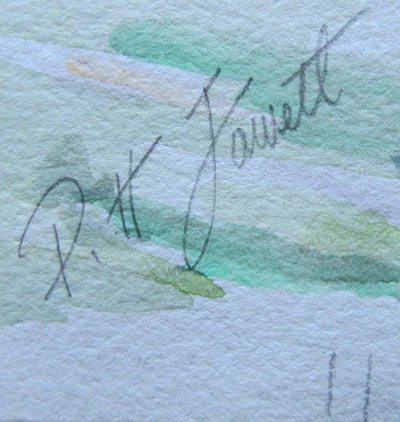
unnamed, Percy Hague Jowett, 12" x 17", watercolor on
paper, 1911
Percy Hague Jowett was a
painter in watercolor and oil of landscapes and interiors
and a teacher. He was born at Halifax in Yorkshire on 1 June
1882. He was married 11 Sep 1912, at St John the
Evangelist, Putney, London, SW, to Enid Ledwood, sister of
the sculptor, Gilbert Ledwood. He studied at Leeds and the
Royal College of Art, under Gerald Moira. Winning the Prix
de Rome, he traveled to Italy. He taught at the
Beckenham School of Art, having returned there after serving
as a Lieutenant in the Royal Garrison Artillery,
seeing action in France and Flanders during World War I. He
was appointed principal of Chelsea School of Art in
1927 and later at the Central School of Arts and Crafts,
1930-5. In 1935 Jowett succeeded William Rothenstein as
principal of the Royal College of Art (RCA), where
he gave the sculptor Henry Moore his first job. The RCA was
evacuated to Ambleside for the duration of WWII. Jowett was
a member of the War Advisory Committee. He retired from the
RCA in 1948.
Jowett exhibited at the Royal
Academy 1907-1920s, Royal Watercolor Society, R.W.A.,
N.E.A.C., New English Art Club, Redfern Gallery, the Fine
Art Society and in the provinces and abroad. He
was invited by the printmaker Claude Flight to join the
Seven & Five Group and exhibited alongside Paul Nash,
Christopher Wood, Ben Nicholson, Henry Moore and Barbara
Hepworth, among others. The Group eventually became entirely
abstract in character, and after this change Jowett and
other figurative artists ceased to be members. His one man
shows were held at St. George's Gallery in 1923, 1925, 1927
and 1929. He was elected a member of the N.E.A.C. 1929,
A.R.W.S. 1936, R.W.S. 1938. His work is in the collections
of many galleries, including the Hepworth, Laing, Leeds
University and Gloucester Museum Service, The British
Government Art Collection and many private collections. The
Michael Parkin Gallery held an exhibition of his work in
1995.

Portrait of Percy Hague Jowett
Jowett lived in London
and died on 4th March 1955 while residing at 28 Drayton
Gardens, SW10. Enid was born 03 Jul 1889, Chelsea, London SW
and died 10 Oct 1971, while residing at 28 Drayton Gardens,
SW10. The Jowetts are buried at Putney Vale Cemetery
and Crematorium, Wimbledon, London Borough of Merton,
Greater London, England.

"Near the Post Office, Vsevolod Sozonov, 13" x 16", oil
on board
Vsevolod Sozonov was born in 1899
in St. Petersburg, Russia. His father was a professor of
chemistry and his mother was a doctor. Sometime after the
1917 Russian Revolution, Sozonov, his mother and a few
friends escaped from Russia to Estonia and Holland and
then to London where his father had found a job as a
chemist. Sozonov studied at an art school in St.
Petersburg and for two years at the Royal Academy Schools
in London. He later went to work for a commercial art
studio in London and traveled to Paris and Antwerp on
commission from his studio. In 1924 he exhibited at the
New English Art Fair in London and later with the London
Group and Mrs. Marchant's Goupil Gallery. He had a solo
exhibition at the Red Fern Gallery in 1934 and another in
Viga in the same year. The first painting he sold in
London was to Charles Aitken a director of the Tate
Gallery. His work was later added to the collection of the
Birmingham Municipality and the Contemporary Art Society.
Sozonov was married to a well known Russian soprano, Maria
Marova, who also lived in London. He continued his studies
in Paris, Venice and London. Sozonov's biography appeared
in the March 1939 edition of The Artist. Sozonov died in
London in 1966.

Self portrait, Vsevolod Sozonov, 16" x
13", oil on board
I found this unframed painting, "Near
the Post Office", at a local thrift shop for $3.77,
including tax. I think it is London scene from the 1920s
or 1930s, judging by the image and the board that it is
painted on. He seems to have consistently signed his work
similarly to the piece in my collection.

Signature
There are several mentions of English
and London scenes in the auction records of Sozonov's
work, so that may have been one of his focuses. There are
a few scratches and scrapes on this piece, but I really
like the motion in the scene and the gray day it portrays.
I had almost given up on finding treasure that day and was
literally on my way out of the door, when I saw it
leaning, half hidden among some other items. Woo and Hoo.
The remnants of a label and the penciled title are verso.
It is somewhat maddening the the label was removed. I made
a place on my wall for this one!
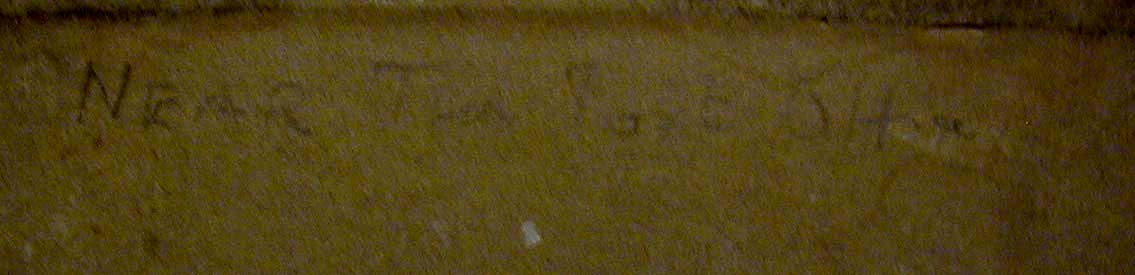
"Near The Post Office"

Remnants of a label, verso


"Aberfeldy, Strath Tay", D. Watts SSA, 12" x 16", oil on
board
David Watts
was active ca 1910 - ca 1938. He was a member of the
Scottish Society of Artists (SSA). I found this at the local
Goodwill store for $7.96 plus tax. Pretty amazing. There is
not a great deal of information available about this artist.
He may, or may not, be the D. Watts listed in The Dictionary
of Scottish Painters 1600 to the Present by Paul Harris.

Title, verso, with manufacturer's label
Watts
titled the painting, verso. "N. B." stands for "North
Britain and this term was used from the 18th century until
the early 20th century. I was able to very easily locate
other examples of Watts' work and signature. He signed
both "D. Watts" and "David Watts".

D. Watts signature

"St. Martin's in the Fields", Dorothy F. Sweet, 9.75" x
6" (plate), etching
This was a $1.99 thrift shop find. It was
horribly framed and I was pleasantly surprised at the
quality of the work when removed from the frame. As can be
seen, it appears to be toned a bit where it was exposed in
the mat, but it might also just be dirty as the framing job
was really crap. After a bit of research I found that this
was a British artist, active in the 1920s and similar work
by her sells in the $300-$500 range, maybe not enough to
warrant restoring this one. Not much information about her
is available, but she is listed in some of my British art
reference books and I did find one skimpy biography for her
on the Internet.
"Dorothy Sweet was a talented English engraver and etcher of landscapes and architectural views, Dorothy Sweet first began to exhibit her art in the early 1920′s with the Abbey Gallery, London, and with the Society of Women Artists. The majority of her art depicted scenes in and around the London area. She was equally skilled at dry point engraving, etching and colour printmaking. . .It is believed that with the beginning of the Great Depression in 1930, Dorothy Sweet, like so many other talented artists, was forced to abandon her career."
Dorothy F. Sweet is listed in The Dictionary of
British Artists 1860-1940.

Inscription

Watermark

"Three Headed Cat", Nichollas Hamper, 6" x 3", oil on
driftwood, 1993
Nichollas Hamper was born in 1956 in
Chatham, England. He attended the Slade School of Art
1975-1979 and the Royal Collect of Art, London
1980-1982. He has a blog
and a web site.
This piece has a label, verso, that bears the title
and name of the artist and notes that it comes from the
estate of David and Maggi Gordon. This couple has been very
active in the Milwaukee, WI art scene and appear to be far
from being in the estate category. Instead, it appears that
the Gordons moved from Milwaukee to New York in August of
2011, so this was more likely a sacrifice to downsizing
before the move. Mr. Hamper confirmed that this was his work
and that his recollection was that it had been sold as a
wedding present for an American couple.

Nichollas Hamper monogram
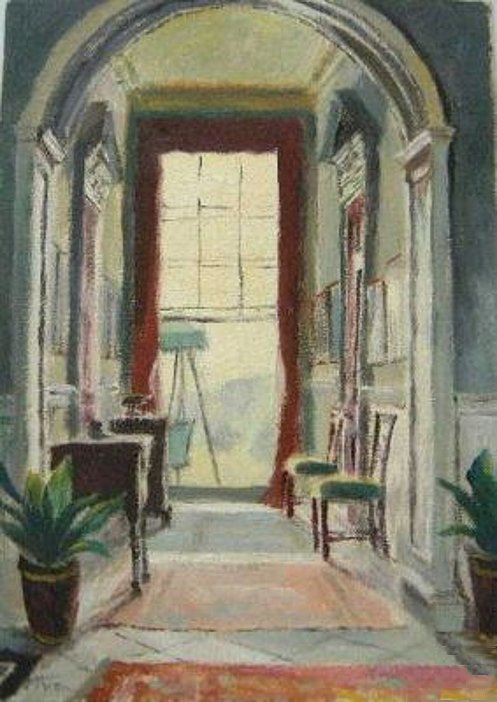
"Dale Park, Petersfield", Margaret Graeme Niven, 10" x 7", oil on thick paper
Margaret Graeme Niven was born in
1906 in Buckinghamshire, a daughter of William Niven, a
well known etcher. Margaret Niven studied under Bernard
Adams at Heatherleys School of Fine Art. She was a
landscape, portrait and flower painter, working in oils,
watercolors, and ink washes. She was elected a member of
the ROI in 1936, on the recommendation of Herbert Davis
Richter. She remained a member, and sat on the council of
the society, for the next 60 years. She exhibited her work
at the Royal Academy, the RBA, RP, Leicester Galleries and
Wildenshtein's and she is represented in a number of
English public collections.
Niven wrote note about this
painting verso:

Niven note
The note reads, "This was
painted by Margaret Niven on a visit to Dale Park with
her artist friend Olive Snell (Mrs. Piler) who spent
her time reading in the swing hammock seen through the
open door! Dale Park was Olive's country home. The
exhibition picture for this "Heatwave at Dale Park"
20" x 15", was shown at the M.S. February 1961, price
25 gns.". The title of this painting is
also written verso.

"A Hampshire Farm", Margaret Graeme
Niven, 7" x 10", oil on thick paper
This painting is titled verso.

"Ovington Mill near Winchester",
Margaret Graeme Niven, 7" x 9", oil on paper
This painting is titled, verso.
Niven died at 3 Broomhill, Sandhills, Godalming,
Surrey on 30 March 1997.

"Early Morning", Bernadette Koranteng, 11" x 14", mixed media
Bernadette Koranteng was born in
1958 in Jarrow, England. She attended Gwent College of Art
and the Royal Academy of Art. She has exhibited at the
Royal Academy Schools, National Portrait Gallery, Mall
Gallery, and other prominent galleries and venues. She has
a web site.
She also teaches, and holds classes at The Biscuit Factory
in Newcastle upon Tyne.

"Wattlesborough", F. C. Leighton, 11.75" x 9", watercolor, Dec. 16, 1850
This small watercolor is signed F.
C. Leighton. The Leighton family have been Baronets of
Wattlesborough for several generations. Baldwin Leighton
was Baronet from 1805-1871, according to Burkes Peerage.
He was the only son of Baldwin Leighton 1747-1828. He
married Mary Parker on 9 February 1832. She was a well
known, and talented artist. Their oldest daughter was
named Frances Christina Leighton, who married Rev. E. G.
Childe on 23 April 1862. I have to wonder if this might be
her work. Frances completed an oil painting of her uncle,
John Parker in 1858. He was also a well known artist.

Wattlesborough Castle and
Hall
I found
this very similar photograph of Wattlesborough Hall.
Wattlesborough Castle was apparently built in the 13th
century and a Georgian farm house was added on to the
ruins of it in the early 1700s, when it became known as
Wattlesborough Hall.
The painting was framed in Pompano
Beach, Florida and purchased from a dealer in Santa Clara,
California, so has had an interesting journey.

Signature and inscription

unnamed, Trevor Lawrence, 9.25" x 6.5", oil, 1983
Trevor Lawrence was born ca 1944,
possibly in Chertsy, Surrey. He had a reputation for being
an eccentric artist, and mostly sold his work mostly in
coffee shops and at street fairs. I have found mention of
works of his dated as early as 1974. His work was included
in the collections of numerous show business folks,
including David Bowie and Jack Palance. He seems to have
painted in mostly abstract or surreal styles. I'd call
this one a mix of both styles.

unnamed, Trevor Lawrence,
9.25" x 6.5", oil, 1983
This is the second of the pair of
Lawrence paintings that I purchased. I try to broaden my
horizons by acquiring new forms of art. This is pretty
broad for me! Collectors of his work seem to be fairly
fanatical about Lawrence's art. He also worked as an actor
and musician. His newer works appear to be much more
brightly colored and actually have a nice use of light in
them. Examples may be found using Google searching. These
are pretty dark and dreary, but very active. They came in
very deep, dark colored wooden frames, like shadowbox
frames, but with the paintings mounted at the front of the
frames. For such small works, they have a noticeable
presence.
Trevor Lawrence died in Weymouth July
2012 and his obituary appeared in the Dorset Echo on 20
July 2012:
Weymouth mourns artist Trevor
TRIBUTES have been received for a much-loved Weymouth painter and musician who has died suddenly.
Trevor Lawrence, 67, was described by friends as one of Weymouth’s ‘characters’ who will be sorely missed.
London-born Mr Lawrence was an actor in his younger days with appearances in TV series such as Doctor Who – and he also became friends with rock star David Bowie after appearing in a film with him.
In Weymouth, where he had lived for 20 years, he was better known as a painter of mysterious and surreal scenes, as well as entertaining pub crowds on the piano, and keeping up a healthy swimming regime off Weymouth beach.
His paintings, which he produced in the early hours of the morning, commanded hefty price tags.
Mr Lawrence, who lived with his mother Joyce in Newberry Road, died peacefully in his sleep.
Martin Leighton, of the Leighton Art Gallery on the harbourside, which has been exhibiting Mr Lawrence’s work for the past five years, said his death had come as a shock.
He said: “He was in the gallery and was chuffed to bits that one of his paintings had gone for £1,800. The next day he was gone. It’s very sad, he was a real character.”
Mr Leighton added: “He had a few niggling complaints one gets in older age but there was no heart trouble as far as I know, his death came out of the blue. It was a complete surprise.
“He kept active and enjoyed life and knew many people. He played the piano and harmonica in the pubs, just had a jam when he felt like it, but he didn’t drink or smoke.
“He was easy going with a great sense of humour.”
Mr Leighton described Mr Lawrence’s acrylic on canvas paintings as ‘unique’. He said: “You couldn’t fail to recognise one of Trevor’s works. No-one painted like him. “His work had actually been growing in popularity.” Mr Leighton said he has a collection of Mr Lawrence’s work still to sell which he expects to be snapped up quickly.
In the past Mr Lawrence’s work has been bought by celebrities including David Bowie, Jack Palance, Clive Owen and the late Claire Rayner.
In an interview with the Echo in 2010, Mr Lawrence said: “A lot of artists just do one type of scene, but all mine are different."
“I actually hate painting, but it is my wife. It doesn’t mind if I go off with other ‘mistresses’, such as my piano playing and swimming in the sea, but she always wants me to return to her at night.”
The funeral of Trevor Lawrence will be held at Weymouth Crematorium on Friday, July 20, at 1.45pm.

Signature

unnamed, Dorothy Colles, 16" x 20", watercolor
Dorothy Colles was born in 1917 in
Cairo, Egypt, a daughter of Morris Colles. She is a well
listed artist. Biography coming....

"Suffolk - Constable Country", V. Fisher, 11" x 14", watercolor
Joseph Henry
Vignoles Fisher who was born in England in 1864. It seems
that either there are a lot of forgeries of Fisher's
signature, or that he signed in several ways, "Vignoles
Fisher", "JHV Fisher", "V. Fisher", etc. The line across
the top of the painting is the mat line from the original
French mat. Not sure if the rest of the painting faded or
the mat discolored the painting. Probably the former,
though the blues in the main part of the image look pretty
good. No discoloration or fading anywhere else on the
painting and I was generally pleased with it when I got it
out of the frame as the glass was pretty dirty and it
looked like there was foxing on the paper. Luckily it was
all on the glass, though this painting would definitely
benefit from a light cleaning. I lined the mat with acid
free paper and reused it so the line does not show in the
re-framed painting, but I wanted to show the whole
painting here.

Inscription on old dust
paper backing
The image above shows the inscription
on the dust paper backing with title and the name of
Vignoles Fisher. The image below shows the inscription I
found on the back of the painting itself. The watercolor
was painted on heavy watercolor paper, with pin holes at
each corner, and taped to the mat at all four corners.

Inscription on back of
watercolor
I suspect the inscription and signature
on the back of the painting were written by Fisher. On
either side of the inscription is a dedication to Mary
from Mollie in pencil.


Dedication on back of
watercolor

Dedication,title, and
signature
Fisher married Rose Ethel Goodman.
He died on 6 October 1945. I will include a more in depth
biography for him, when I have time.

Fisher's signature

"Sheepwash Bridge", Byron Winston Warmby, 11" x 16", watercolor
Byron Winston Warmby FRSA was born
in 1902. He was a painter in oils and watercolors. He
studied art at the City of Sheffield College of Arts and
Crafts from 1920-1926. According to Who's Who in Art, he
was a member of FIAD in 1943. I have not been able to find
out what this abbreviation stands for. Today it is used by
a group of international film distributors. He was made a
Fellow of the Royal Society of Artists in 1944. He was a
member and honorary president of the Sheffield Society of
Artists 1947-1948.
Warmby is mentioned in The Year's Art 1940
publisher
J. S. Virtue & Co., The Dictionary of
British Artists 1880-1940 by Johnson, Dictionary of
British Artists Working 1900-1950 by Waters, Davenports Art
Reference and Price Guide, and Who's Who in Art
1968, 1977. He exhibited at least once at the Royal
Academy, though he was not a member there. He exhibited at
least twice at the Royal Society of British Artists in
Birmingham.
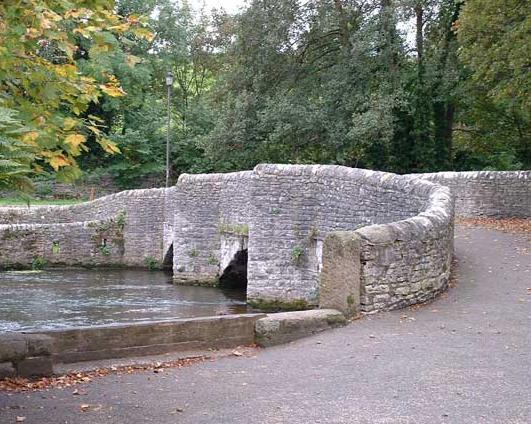
I was really attracted to the
watercolor. I like the Autumn colors and historical
subject matter. The Sheepwash Bridge is a famous bridge
with a stone enclosure nearby where sheep were washed
prior to shearing. I found many images of this bridge on
the Internet and this scene is very typical,with onlookers
standing on the bridge watching swans and ducks in the
river. The river is the River Wye.
Byron Warmby died in 1978.


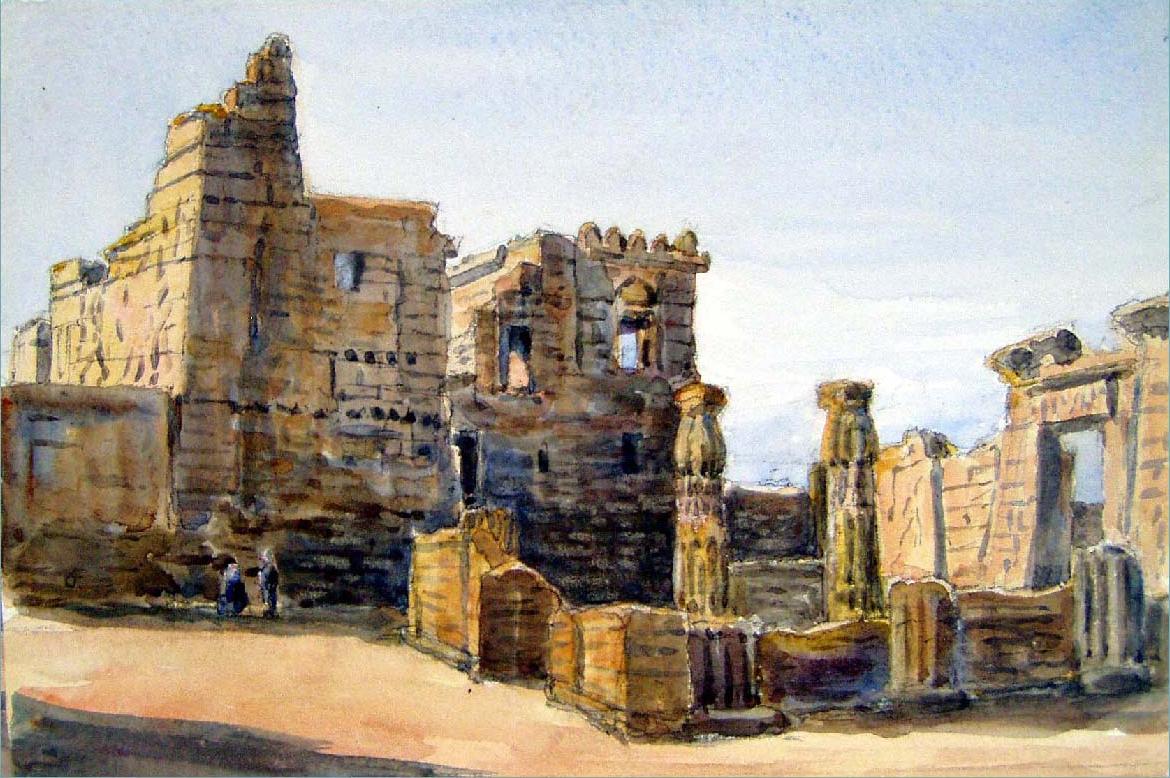
"Medinet Habu, Luxor, Egypt", Charles Gilbert Heathcote, 7" x 10.5", watercolor, 1903
Charles Gilbert Heathcote was born
into a prominent family in 1841 at Conington Castle,
Huntingdonshire in the South Midland District of England.
He was the son of John Moyer Heathcote and Emily Frances.
John Moyer Heathcote was also an artist and was acquainted
with many prominent artists of his time including Peter
DeWint and David Cox. Charles Heathcote was a prolific
watercolorist, completing over 500 watercolors, mostly
plein aire works, but his work was largely unknown because
he kept it in large portfolios in the the library of the
family home. He educated at Trinity College Cambridge and
became a Fellow of Emmanuel College where he was also a
Tutor. Charles was Stipendry Magistrate of Brighton and
Chairman of the Board of the Municipal Science and Art
Schools of Brighton. Along with his father he exhibited
his watercolors at Peterborough School of Science and Art
from 1874 to 1887 but neither Heathcote sold their works.
Heathcote traveled to at least 22
countries and painted in many of them, though the majority
of his works are of English scenes. A large selection of
his works were exhibited at the Dixon Gallery and Gardens
in Memphis, Tennessee in July and August of 1984, a
century after his works were last shown at Peterborough.
This watercolor was part of that exhibition. He is
mentioned in Mallalieu's British Watercolour Artists up to 1920.
Charles Gilbert Heathcote died in 1913.

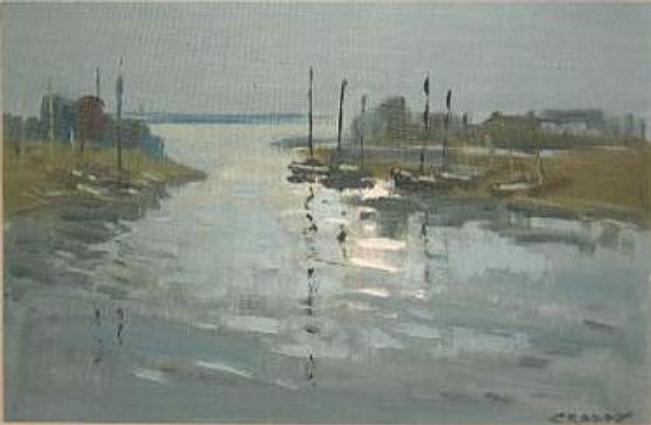
"Harmony", Eric Haysom Craddy, 10" x 14", oil
Eric Haysom Craddy ARWA was born in
1913. He won a choral scholarship to the Bristol Cathedral
School and then attended the Bristol School of Municipal
Art where he studied under Reginald Bush. He was
apprenticed as a designer at Mardon, Son, & Hall where
he worked on cigarette cards and retired in 1973. He
became a member artist of the Bristol Savages in 1937 and
served as that organization's president for three terms.
He exhibited regularly at the Royal West of England
Academy and was elected an Associate in 1947. He worked in
oils and watercolors and specialized in marine scenes. On
the back of "Harmony" it is noted that this is a "Bristol
Savages Evening Sketch", fully signed, and dated 1972. The
Bristol Savages traditionally meet on Wednesday evenings
and must complete a painting that evening for it to be an
"evening sketch". I suspect the second painting is also an
evening sketch.

unnamed, Eric Haycom
Craddy, 10" x 14", oil
He is mentioned in The Savage Spirit and
Davenport's Art
Reference and Price Guide.
Craddy died at the age of 94 on 1
May 2007 in Bristol.

"Storm Approaching", James Orrock, 11" x17", watercolor
James Orrock was a well known
British art collector, illustrator, landscape and
watercolor artist. He was born in Edinburgh in 1829 the
son of a prominent dentist. He was educated in medicine,
surgery, and dentistry at Edinburgh University and
Leicester Dispensary winning two gold and one silver medal
for his studies. He worked as a dentist, setting up a
practice in Nottingham. He studied painting
under James Ferguson, William L. Leitch, and John Burgess
and later attended the Nottingham School of
Design where he won a medal. Orrock arrived in London by
1866 and became an associate of the Royal Institute of
Painters in Watercolours in 1871 and a full member in
1875. Between 1858 and 1882 he exhibited at the Royal
Scottish Academy and Royal Academy.

Orrock was a well known collector
and proponent of British art. He had a large collection of
British art and opened his home as a semi-public museum.
His work as an advocate for and collector of British was
so notable that a hefty two volume biography of him was
written in 1903. I have a copy of this set.


unnamed, John C. Syer, 12" x 19.5", watercolor
John C. Syer 1846-1913 was a son
of well known painter John Syer and brother of painter
James Syer. While this painting is signed J.Syer, it was
identified as being by the younger John Syer by the
seller. John Jr. is not considered to have been the equal
as an artist of his more famous father. Still, this is a
nice country scene. Syer served in the navy until 1870
later settling at Whitby and exhibited paintings in
Bristol and York. Mallalieu describes John Jr. as a marine
painter and James as a painter of marine, Welsh, Scottish,
and Irish landscapes. I am really not certain at this
point which of the three J. Syers is the painter of this
watercolor. All three are well listed artists.

unnamed, William Widgery, 9.5" x 13.5", watercolor
William Widgery was born in 1822 or
1826 in Uppercot, North Molton, Devon, England. He worked
as a plasterer and stone mason before becoming a self
taught painter in oils and watercolors of landscapes,
marine scenes, and animals about 1850. He began by
painting copies of popular engravings in his free time and
was encouraged by his friends and a local Exeter innkeeper
named Thomas Hex to become a full time artist. He was very
successful as an artist and a biography written about him
in 1881 claimed that he had painted 3000 paintings and
sold them all, many right off the easel, before they were
dry. This painting came from a folio of his paintings,
some signed and some unsigned. This one is not signed. The
owner of the folio estimated the paintings were done about
1860 and guessed that this one was a coastal scene of
Italy or Switzerland where Widgery is known to have
visited at least two times. I have not seen other marine
paintings by Widgery for comparison, but the landscapes in
the folio were very similar to other Widgery works that I
have seen.
Widgery is well listed in British art
reference books covering the time when he was active.
Widgery died in Exeter in 1893. He was the father of well
known British painter Frederick John Widgery who was also
Lord Mayor of Exeter. Both Widgerys and also a daughter of
William were very popular local artists.

"Mountain Tops, Aethury y Coed, North Wales", G. Harlow White, 4.5" x 8.5", watercolor
George Harlow White was born in England in 1817. Harlow was a painter in watercolors and artist in ink and pencil. His mother, Elizabeth Harlow White, was an artist and her brother was George H. Harlow RA. White attended the Charterhouse School, London, started painting in 1830, and was employed as an artist after that time. He immigrated to Canada in 1871 where he is rumored to have bought a bush farm in Oro Township north of Toronto. More likely he settled near there but traveled the surrounding counties and provinces working as an artist. He made many pencil drawings and watercolors of pioneer life during his time in Canada, for which he is best known today, though he painted for many years in England, Wales, Ireland, and Scotland. It is thought that he lived in Toronto for a time before returning to England in 1878. He was elected a member of the Ontario Society of Artists (OSA) in 1873 and was elected an honorary non-resident member of the Royal Canadian Academy (RCA) in 1880. He showed his work at both societies well into the 1880s.
This painting is titled in pencil
on the back of the mount. The writing is very light and I
used Gimp to bring it out as much as possible. I have
interpreted the title as best as I able. Corrections
welcome. Update: Thanks to Stephen Miller for his
correction on my reading of the title.

This painting is signed G. Harlow White RCA so can be dated to between 1880 and 18 December 1887 when Harlow died at the Charterhouse, London. The label on the back of this painting shows that it came from the estate of well known Canadian artist and art critic John Thrift Meldrum Burnside. Harlow is well listed in British and Canadian reference books.


unnamed, Francis A.W.T. Armstrong, 9" x 13", watercolor
Francis
Abel William Taylor Armstrong RBA RWA was born on 15
February 1849 in Malmesbury, Wiltshire County, England a
son of Francis Armstrong and Elizabeth Ann Leonard. He
received a private education. He was an illustrator,
etcher and painter in watercolors and oils. I originally
identified this painting as "attributed to" FAWT Armstrong
as it did not strongly resemble other works that I had
seen by this artist and I had not been able to find an
example of his signature. Since that time though I have
found another example of Armstrong's work that is exactly
the same size, similar in color palette, style, and
subject, and signed similarly so I am now comfortable
declaring this painting as his work. The other work was
guaranteed to be Armstrong's work by a well known auction
house. Armstrong's works are frequently reproduced as
prints.
The Victoria and Albert Museum has a
dozen or so of Armstrong's paintings in their collection.
Drawings and sketchbooks by Armstrong were donated to the
Museum by his children, after his death. An etching by
Armstrong is offered for sale in Rambles and Rides
Around Oxford by Herbert Hurst (1885). He was
elected to the Royal Society of British Artists in 1895,
to the Bristol Savages in 1905 and to the Royal West of
England Academy in 1908. Armstrong moved to Bristol,
England in 1905. He was Artist's Chairman of the Royal
West of England Academy at the time of his death in 1920.
He exhibited at the Frost & Reed Gallery, Bristol
(1895), 126 works at the Bristol Fine Arts Academy (1896),
54 works at the Royal Society of British Artists (1909),
40 works at the Ryder Gallery (1910), etc. Armstrong
exhibited widely, including in London, Paris (Paris
Salon), Berlin and Dusseldorf. Several of his works,
including oils, watercolors and etchings were part of the
permanent collection of the Bristol Art Gallery in 1911.
One of his claims to fame is his participation as an
illustrator to the well known novel Lorna Doone.
Armstrong is mentioned in Who's Who
(1902, 1904) by Addison, British Etchers 1850-1940
by Guichard, Dictionary of British Watercolour Artists
up to 1920 by Mallalieu, Dictionary of British
Artists 1880-1940 by Johnson, The Savage Spirit
by Hudson and Davenports Art Reference and Price Guide.
I was informed by a biographer of
Armstrong's that the painting in my collection is a view
of the Bristol Channel from somewhere in the hills between
Portishead and Clevedon. This is one of my favorite
paintings.
Armstrong died on 1 December 1920.

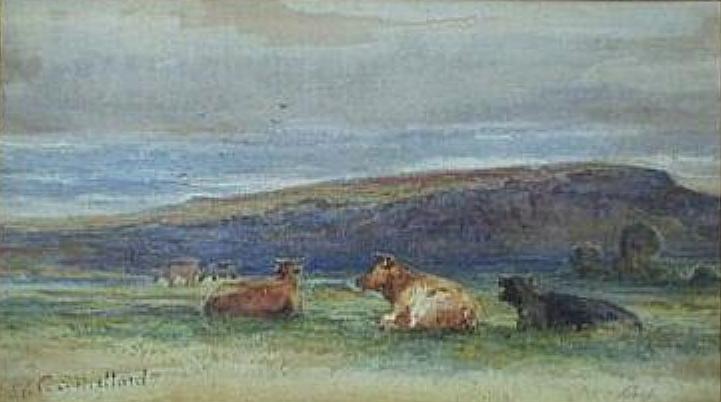
"Rest", C. S. Millard, 5.5" x 9.25", watercolor
Charles Stuart Millard was born on
22 June 1837 in Weston, Ontario, Canada. Millard was
primarily a landscape painter in watercolors and oils. He
was one of the founding members of the Ontario Society of
Artists in 1872 in the company of such notable artists as
Thomas Mower Martin. He was also a founding member of the
Royal Canadian Academy. Millard moved to England before
1879 when he was employed as an instructor at the South
Kensington Art School, London. Millard was later appointed
to the Cheltenham School of Art where he served as
Headmaster for many years. Millard spent the remainder of
his life in England. He was a close friend of Thomas
Collier RI, and it is from Collier's letters to Millard
that Adrian Bury obtained much of the personal information
about Collier for his definitive work on that artist.
Millard even appears in one of Collier's paintings.
"Rest" is one of a pair of Millard
paintings that were part of the estate of well known
Canadian artist, art collector, and critic John Thrift
Meldrum Burnside. I suspect that this painting was created
by Millard before he moved to England in the late 1870s.
The painting below of a Welsh landscape came from a seller
in England and was probably a later work by Millard. This
one is signed verso, so perhaps he did not want to detract
from the image. This came from a set of his paintings,
some signed on front and some on back, and all appearing
to be Welsh landscapes. Several of Millard's
watercolors are in the Victoria and Albert Museum
collection.

unnamed (Welsh landscape), C. S. Millard, 8" x 13", watercolor on paper

unnamed, C. S. Millard, 16" x 20", oil on canvas board

C. S. Millard signature from this oil painting
Millard died on 7 November 1917 in
Cheltenham, England.

"Near Plexford, Surrey", Robert Thornton Wilding, 8" x 12", watercolor, 1916
Robert Thornton Wilding was active
as an artist from the late 19th through early 20th
century. Luckily he dated is works and I have seen works
dated as early as 1892 and as late as 1928. He was best
known for painting marine watercolors, though he also did
some cottage scenes and landscapes. The painting above is
one of the most elaborate cottage scenes by him that I
have seen. This image does not do it justice and I will
get a better one as time permits. Wilding is not well
listed but was very prolific. I think he is under rated.
He is mentioned in The Dictionary of
Neglected Artists working 1880-1950 by Jeremy
Wood. Wood notes that his style and subject matter
are similar to that of Thomas Bush Hardy and that his best
work could be mistaken for Hardy's work. I have seen one
claim that Wilding was Hardy's nephew, but have not been
able to confirm that. My email to the gallery owner making
this claim was not answered. Wood notes that Wilding did
not exhibit, probably a contributing factor to his
relative obscurity. Wilding was living in Wimbledon, South
London in the early 1920s according to Wood.
I like Wilding's work and also have a
small landscape by him. After his signature on that
painting he added ARA for Associate of the Royal Academy.
In the record of another auction I see that he added FRA
after his signature, which was perhaps meant to mean
Fellow of the Royal Academy, though I do not think such a
designation exists. When I contacted the library of the
Royal Academy I found that Wilding had never had any
affiliation with that society. The scamp. One
collector that I know detests Wilding as he apparently
also actively counterfeited the works of other artists. I
have seen one work signed "T. B. Hardy" that is attributed
to Wilding. I do not know how this attribution was made.
He typically signed his work R. T.
Wilding. He is also listed in Davenport's Art
Reference and Price Guide. This painting came in
a nice period American frame with label intact. I have not
had it out of the frame yet, so the picture has some glare
from the glass.


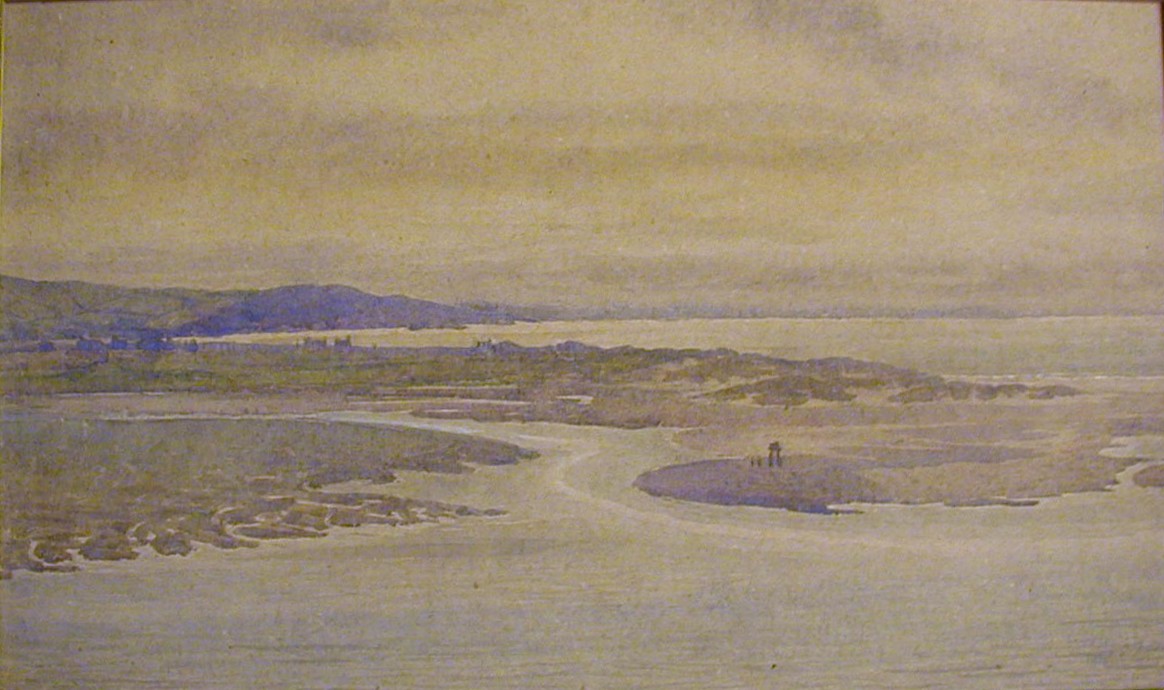
unnamed, Buddig Anwylini Pughe, 11" x 19", watercolor, 1910
Buddig Anwylini Pughe was born in
1857 in Aberdovey, Merionetshire, Wales the daughter of
Dr. John and Catherine Samuel Pughe. She was a painter of
landscapes and portraits in watercolor and oils. The
Museum of Wales spells her middle name as Annylini. Her
other work that I have seen is much grander. This work is
painted on a card and has darkened somewhat as a result.
It took me a long time to like this painting. It is one of
those paintings that looks better the further you get from
it. It also came in a frame that it took me awhile to
like, thickly but smoothly painted in white and lavender
with gold inner detailing and sized to fit the painting
with no mat. This hung in my closet for several months,
but now is in my dining room.
Miss Pughe studied at the Liverpool
School of Art and also in Paris and Rome. She painted in
France, Spain, and Italy. She was a member of the
Liverpool Academy of Arts. Miss Pughe exhibited widely
between 1882 and 1938 at the Royal Academy, Walker Art
Gallery, Royal Cambrian Academy, Royal Hibernian Academy,
Royal Institute of Painters of Water-Colours, Royal
Society of Artists Birmingham, Royal Scottish Academy, and
more. The Museum of Wales seems to have some of Miss
Pughe's paintings and also one or more of her scrapbooks.
She is well listed, mentioned in Welsh Painters
by Rees, The
Dictionary of Victorian Painters by Wood, The Dictionary of
British Artists 1880-1940 by Johnson, etc.
Miss Pugh died in 1939 in Liverpool,
England.

unnamed, Edmund Morison Wimperis, 11.25" x 17.25", watercolor, 1887
Edmund Morison Wimperis was born at
Flocker's Brook, Chester, England on 6 February 1835,
eldest son of Edmund Richard Wimperis, cashier of Messrs.
Walker, Parker, & Co.'s lead works at Chester, and
Mary Morison. He came early in life to London, and was
trained as a wood-engraver and draughtsman on wood under
Myles Birket Foster. He did much work for the 'Illustrated
London News' and other periodicals and books. He was
considered to be an indifferent figure draughtsman, and
confined himself mostly to landscapes when he adopted
painting as his profession. He was a member of the Society
of British Artists from 1870-1874. He began in 1866 to
contribute to the Institute of Painters in Water-colours
landscapes in the manner of Birket Foster or of David Cox
in his tamer moods, for which he is best known. His work
was seen to be old-fashioned in technique. Late in his
career he started to paint and sketch with Thomas Collier.
This association is considered to have freed him to paint
more freely with less of the engraver's attention to
detail. The painting above, though painted during his
association with Collier, I think mixes both the more
antiquated style he learned from Foster and the breadth of
nature that he learned from Collier. I have seen other of
his works painted around the time of this painting that
are the stormy, dark wide landscapes minus people that he
is better remembered for. Later in life he also painted in
oils.
Wimperis was elected an associate
of the institute in 1873, a full member on 3 May 1875, and
vice-president on 1 April 1895. He took an active part in
the affairs of the institute, and in those of the Artists'
Benevolent Fund. In 1879–80 it appears that he
accompanied his two sisters Fanny and Jenny when they
joined another sister, Susanna, married and living in
Dunedin, New Zealand. He stayed there for several months,
exhibiting at the Otago Art Society in 1880.
He was married on 11 April 1863 to Anne
Harry, daughter of Thomas Edmons of Penzance, and left a
family of two sons and two daughters at his death, which
took place at Southbourne, Christchurch, Hampshire, on 25
Dec. 1900. His children were all talented artists of one
sort or another. Wimperis is listed in all of the major
British art reference books that cover the period that he
was active and his work is held by most of the prestigious
British museums.

"Arundel Castle", Edmund Morison Wimperis, 9" x 13.5", watercolor
This is the watercolor that no one
seemed to want. It was offered by a knowledgeable and
reputable seller in Portugal on ebay starting at about
$1000 to "buy it now", which is about right for a nice
work by this artist. It was noted that it came from a
private collection and several other good works by
different well known artists from this collection were
also offered by the seller. I have done business with this
seller in the past and trust their judgment. It did not
sell and the seller offered it several more times, each
time at a lower reserve. There were numerous bids, but
none met the reserves. I had bid on it at a much lower
price a couple of times but did not meet the reserve, and
when the seller did get down to the price at which I had
been bidding, I decided to pass on it, and eventually
someone purchased it for $365. It is laid on a card and
was not framed, though it did come with a nice French mat,
which may be why it did not sell. A few weeks later it was
back on ebay, now passably framed but with the same French
mat, offered by a new American seller for a starting price
of much less than what it had last sold for. The "buy it
now" price was $550. I was the only bidder this time and
got it for the much lower starting price. Go figure. It
may be that these English works don't sell well in the US
and shipping costs to and from the UK are so high right
now, that it is is a barrier to UK bidders. It is very
much in the style of Wimperis, bears his monogram, is in
fine condition, and probably not worth faking, so I am
pretty comfortable that it is genuine, but maybe someone
knows something I don't.
I was amused to note that the new
seller had copied my biography for Wimperis from my web
site for his ebay auction.

"The President, Thames B", Robert W. A. Rouse, 6" x 9.5", watercolor
Robert William Arthur Rouse R.B.A.
was born in 1867 in Kennington, Lambeth, Surrey. He was a
landscape painter, etcher, and illustrator. He was elected
to the Royal Society of British Artists in 1889. He
exhibited at the Royal Academy (45), Royal Society of
British Artists (64), Walker Art Gallery Liverpool (15),
Royal Institute of Oil Painters (13), and many other
prominent galleries. This is a nice little painting, very
detailed. The blue paint in the center of the painting
over the bridge may or may not be intentional. I am not
sure if this is the result of an accident or is meant to
be a pennant or smoke. Hard to say, though it appears to
be intentional. The brown areas in the right center of the
painting that could appear to be stains actually seem to
be clouds of smoke from the smoke stacks there. The words
"The President Thames B" are written on the back in pencil
and I assume that to be the title of this painting. I can
not make out any writing after the final letter "B" though
it may have faded or been rubbed away.
The first of several HMS Presidents was
the USS President, a 44 gun Frigate, captured by the
British from the Americans in 1815. The ship was renamed
HMS President and broken up in 1818. The USS President was
one of the original six US frigates; Constitution (44),
President (44), United States (44), Congress (38),
Chesapeake (38), and Constellation (38). This ship is
probably the training ship which was commissioned under
the name of HMS Buzzard in 1887, became a drill ship in
1904, and renamed HMS President in 1911. She was
used by the London division of the Royal Navy Volunteer
Reserve and was typically moored in the area shown in the
painting. She was apparently decommissioned in 1921 which
helps to date this painting to 1911-1921. Thanks for Alan
Jarvis for this link.
R.W.A. Rouse is mentioned in all of the
major British art reference books that cover the period
when he was active. Rouse died in 1951 in Oxford.

unnamed, Clifford Montague, 6" x 8.25", watercolor, dated 1883
Clifford Montague was a British
painter of landscapes and seascapes in oils and
watercolors. Much information about him is given in
a Pontgarreg, Wales newspaper, The Gambo. Montague was
born in March 1858 in Tilehurst, Berkshire, England.
He received his training at the London School of
Arts. He is typically described as having
exhibited between 1883 and 1900, though I have seen one
work of his dated to 1916. It may be that he stopped
exhibiting in 1900 but continued to paint. He exhibited at
the Royal Society of Artists, Birmingham (19), Walker Art
Gallery, Liverpool (2), Manchester City Art Gallery
(2), Royal Hibernian Academy (1), and Royal Scottish
Academy (1). Montague is often described as a
Birmingham painter but he also lived in Berkshire
in 1861, Kent in 1871, Devon in 1881, Penkridge
in 1891, and Cardiganshire, Wales in 1901. He
gave his occupation as "Artist" in 1881, 1891, and 1901. Montague
was a well known landscape artist and received commissions
to paint in Britain, Ireland, France, and the Netherlands.
One of his favorite subjects was mills. Montague
is mentioned in The
Dictionary of Victorian Painters by Wood, The Dictionary of
British Artists 1880-1940 by Johnson, British Watercolour
Artists up to 1920 by Mallalieu, and Davenport's Art
Reference and Price Guide.
Montague married a woman from
Holsworth,
Devon named Jane in 1883. They had nine
children and two of their sons died in WWI. Montague
moved his family to Pencwm House, Post Bach, Ceredigion,
Wales in 1913 and to Bryndewi House, Pontgarreg,
Ceredigion, Wales in 1914. Clifford Montague
died there in June 1917 at age 59. His death is recorded
in the records of Newcastle in Emlyn, the district which
contains Ceredigion. He is buried in Dewi Sant Church,
Blaencelyn. Montague never made a great deal of money
during his life time, and his family could not afford a
tombstone for his grave.
Once again, I forgot to
photograph this painting when I had it out of the frame to
replace the old backing, but this image is not too bad.
The horizontal line in the middle of the painting is glare
from some part of the camera. The whitish spots in the
center of the painting are actually leaves and as they
appear in the painting. This little painting is in really
great shape and in the original frame and mat. I decided
to save the mat as it is unusual, but backed it with heavy
acid free paper and remounted the painting to the acid
free paper. The mat is whitish, discolored with age, with
a gold inner mat which is shown, but then a second inner
mat of thin black paper was added, possibly to enhance the
black bird that is keeping company with the two white
birds in the lower right. It looks to me like that artist
used the color of the paper the painting is painted on in
the sky.


"Sussex", E. D. Riley, 9" x 13.25", watercolor, 1936
William Edward Riley R.B.A. was born Ossett, W. Riding in 1852 son of a fireworks manufacturer. He worked primarily as an architect and was very prominent in that field, which may explain why information about his work as an artist is scarce. He was a member of the Art Workers Guild.

"Rye", E. D. Riley, 10" x 14", watercolor
Riley went to Batley Grammar School and was articled to William Crutchley of Wakefield in 1868. In 1872 he became assistant to Beck and Lee of Finsbury. Riley joined the staff of the Admiralty Works Department in 1877 where he served for twenty-two years and attained the rank of Assistant Director. He was appointed Chief Architect for the London County Council (LCC) in 1899. He retired from the LCC in 1919 and entered into partnership with E B Glanfield. He retired in 1931 from his work as an architect. Riley was a frequent contributor to the Royal Institute of British Architects Journal of which society he was a fellow. I have seen one reference to him as "architect and surveyor, Gray's Inn", which suggests that he was also added barrister to his list of accomplishments. He is mentioned in Ordering Law: The Architectural and Social History of the English Law Court by Clare Graham. He exhibited from 1906, including the Glasgow Institute of Fine Arts (1), Royal Academy (4), and Royal Society of British Artists (208).
Riley is mentioned in The Dictionary of British Artists 1880-1940 by Johnson and given the designation RBA. This is the only indication that I have seen that affiliates him with the Royal Society of British Artists though it is not too surprising as he exhibited there frequently. I have sent an email to their library to try to confirm this. Riley's biography appears in Edwardian Architecture A Biographical Dictionary by Gray. William Edward Riley died on 9 November 1937.
The painting below is not signed.

"The Artist's Garden", E. D. Riley, 9" x 13.25", watercolor
The seller of these paintings
claimed this painting was titled as shown above,
possibly because other, similar paintings had the
title written on them. This one has nothing to
indicate the title, and appears to have been laid down
at some point.

Riley's signature from one of my paintings.

unnamed, Thomas Phillips, 9" x 14.5", watercolor
Thomas Phillips was a landscape
painter who lived in Liverpool, England in 1886. He also
lived in Seacombe in 1894 and in Liscard, Cheshire in
1904. Not much is known about him, but he exhibited 54
paintings at the Walker Art Gallery, Liverpool, and 11
paintings at the Royal Cambrian Academy. He exhibited
from1886 through 1913, according to The Dictionary of
British Artists 1880-1940 by Johnson. His work
was very nicely done.
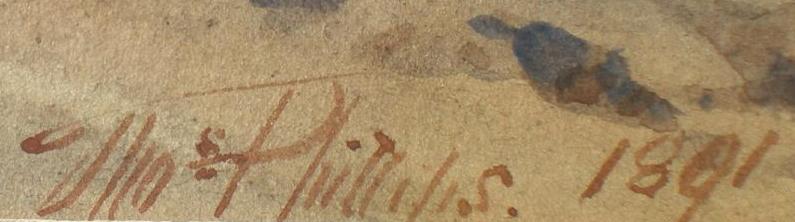

Gathering the Bracken, Percy Lancaster, 9.25" x 13.25", watercolor
Percy Lancaster was born in
Manchester, England on 28 November 1878. He was educated
in that city and trained as an Architect, but later turned
to painting and studied at the Southport and Manchester
Schools of Art. He painted landscape and figural subjects
in both oil and watercolor and also produced some etchings
of fine quality. It has been noted that he was one of the
rare artists who was able to do landscapes and portraits
with equal skill. Mallalieu notes that he was a landscape
painter in the style of Cox and Collier. Lancaster was
elected and Associate of the Royal Society of
Painter-Etchers and Engravers in 1910, and a full member
of the Royal Society of British Artists in 1914, and of
the Royal Institute of Painters in Watercolours in 1921.
This painting probably dates from between 1914 and 1921.
Lancaster is recorded as living in
Southport and his work is represented in the South
Kensington Museum, London; and in Manchester, Liverpool,
Hull, Oldham, Huddersfield, Preston, Leicester,
Eastbourne, Newport, and Portsmouth. He died in Southport
on 2 November 1951.

"Poole, Dorset", Anita Waite, 8.5" x 11", watercolor
Anita Waite was a Nottingham
artist who exhibited at the Nottingham Museum and Art
Gallery 33 times between 1909 and 1924. According to The Dictionary of
British Watercolor Artists 1880-1940 by Johnson,
she held the designation of A.N.S.A., which I think
may stand for Associate of the Nottingham School of Art.
Just a guess, as Johnson does not include an explanation
of this abbreviation. Ms. Waite does not appear in any
other art reference book that I have searched and I have
found no references to her using the major Internet search
engines, or genealogical search tools. I would
appreciate any additional information about her.

"Pitney, Somerset", Henry John Sylvester Stannard, 10.5" x 14.5", watercolor.
Henry John Sylvester Stannard was a
Bedfordshire Landscape Painter, son of Henry J.Stannard,
and father of Theresa. Stannard. He specialized in
watercolor, and painted landscape and rustic subjects. He
was born in London on 12 July 1870.
Stannard was educated at the Bedford
Modern School and the National Art Training School, South
Kensington, where he won his Art Teachers Diploma at the
age of 16. He was a member of many Art Societies and was
elected to the Royal Society of British Artists in 1896.
In addition to his reputation as an accomplished artist at
this time, Stannard also became well known as a lecturer,
teacher and judge of art exhibitions. His international
career began after he received interest and patronage from
the British Royal family. He painted many pictures of
their Sandringham estates and he received many personal
commissions from them. Stannard was painter to Queen
Alexandre (wife of King Edward VII).
Despite his fame, Stannard still
supported local exhibitions including the Bedford Society
of Artists and his father's exhibitions in Harpur
Street. He was the founder of the Harpers Art
Society, Bedford in 1895, and the inventor of the
Sylvester Stannard Straining-Board for Watercolour Paper.
He.spent most of his life in Flitwick, Bedfordshire. In
1939 he founded the Midland Sketch Club. It was at the
1950 annual exhibition of this club (in the Bunyan Room of
Bedford Public Library) that Stannard exhibited his last
works.
His most characteristic works are
cottage and village scenes painted in the tradition of
Birket Foster. Exhibited widely: Royal Academy 35
works, Royal Society - British Artists 70 works,
Royal Cambrian Academy 1 work, Royal Institute 29 works,
Birmingham 6 works, Royal Hibernian Academy 1 work,
Manchester 8 works, Liverpool 13 works , and elsewhere.
Stannard died on the 21st January 1951 at Bedford
Hospital.
He is mentioned in Mallalieu's British Watercolour
Artists up to 1920, Davenport's Art
Reference and Price Guide, Wood's Dictionary of
Victorian Painters, and many other art reference
books.
This is one of his later works.

"A Brook by the Roadside Nearing Windsor", John Fullwood, 10.75" x 13", watercolor.
John Fullwood was a successful
landscape painter, etcher and illustrator. He was born in
England in1854 and studied in Paris and Birmingham,
England. His paintings were displayed at the Royal Academy
on 21 occasions and by the Royal Society of British
Artists on 99 occasions. From about 1874 to 1900 Fullwood
was based in Birmingham and lived in Broad Street. He
displayed no less than 67 paintings at the Royal
Birmingham Society of Artists exhibitions. Around 1900
Fullwood moved to Sussex and worked there for about 10
years. He also had a house at Twickenham and considered
the display of his paintings in major London galleries as
the most important part of his career. John Fullwood died
at Twickenham on 9th September, 1931, at the age of 76. He
was a member of the Royal Society of British Artists and
one of the oldest members of the Royal Birmingham Society
of Artists. He is listed in Davenport's Art Reference and Price Guide,
Mallalieu's Dictionary
of British Watercolour Artists, Wood's Dictionary of
Victorian Artists, and other reference works and
his works have sold at auction many times.
Below is an example of one of
Fullwood's copper plate etchings, a signed artist's proof,
from my collection.

Hampton on Thames, John
Fullwood, 10" x 14", copper plate etching
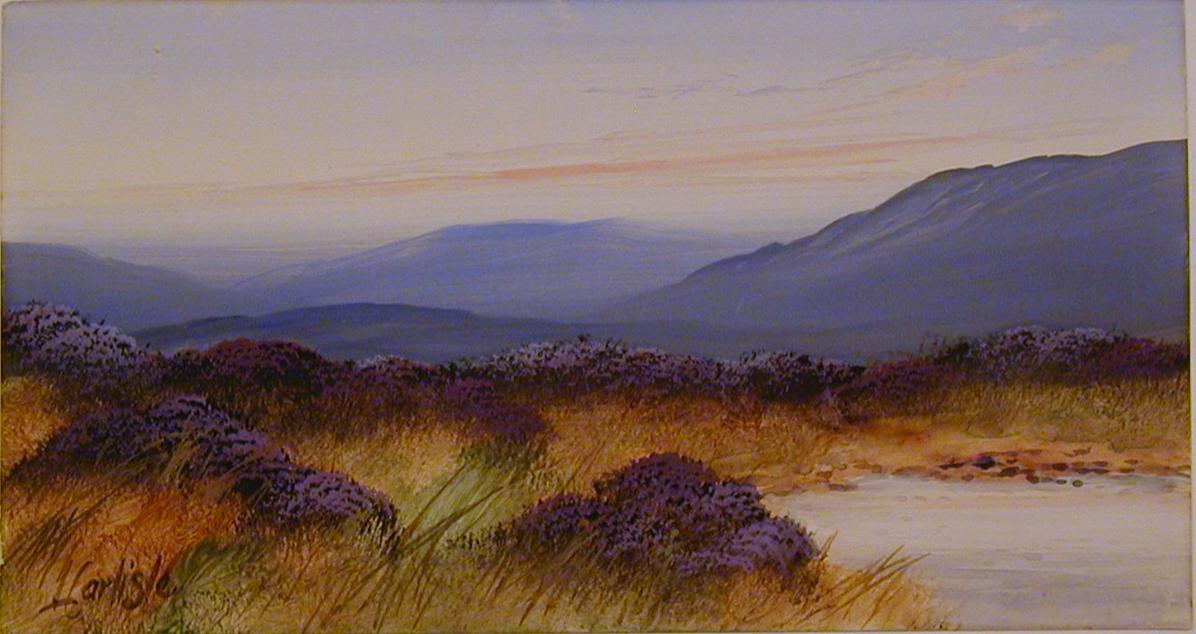
"Moorland Landscape" L. or J. Carlisle, 5 7/8" x 10 7/8", gouache.
This artist's work is often attributed to John
Carlisle (1866-1916), a listed British painter. I
greatly doubt that this is correct. I have been able
to locate only two images of works that can definitely
be attributed to John Carlisle (1866-1916) and the
signatures and style are very different from those of
this artist. This artist's first initial sometimes
resembles an "L" and other times a "J", and it is
uncertain which it is. There may even have been two
artists painting in a similar style, both named
Carlisle or one imitating the other. Two of the
paintings that I have seen clearly signed "L.
Carlisle" had some kind of sheep, goats or musk oxen
in the painting, and the style was a bit different,
with the paint much more thickly applied than average
works by Carlisle. These are the only Carlisle
paintings I have seen with animals in them. Most are
empty, mountainous landscapes which prominently
feature heather.
Since not much is published about
John Carlisle (1866-1916), I am including a brief
biography for him. John Carlisle was a British
landscape painter in watercolor and gouache. He lived
in London and Dorking and later at Keats Cottage,
Hampsted. He exhibited from 1866 to 1916 and
painted in Devon, Wales, Scotland, and Guernsey, as
well as in the south of England. He traveled in Italy
and exhibited at many of the mainstream British
societies and galleries (sixty-two paintings exhibited
at Walkers Gallery in London). His biography appears
in Mallalieu's The Dictionary of British Watercolour
Artists up to 1920.
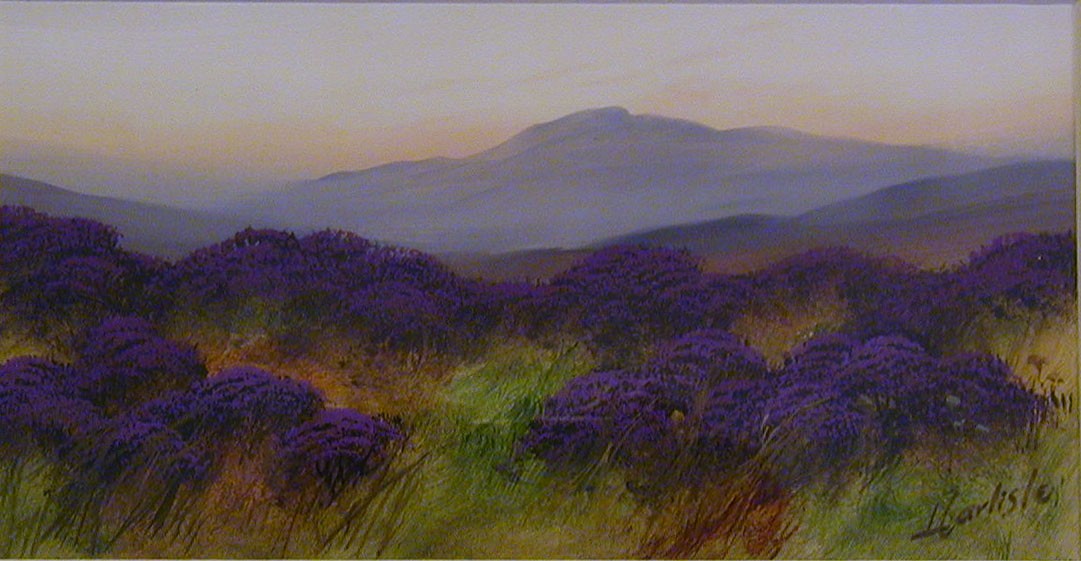
"Scotch Heather" John Carlisle, 5 7/8" x 10 7/8", gouache.
There
is some minor damage to the painting in the first
image, a couple of pinholes that can be easily
repaired, in the upper left corner of this painting.
The gallery owner who sold this painting to me
actually owned it about 30 years ago when he was
living in Scotland but later sold it. He opened a
gallery in Massachusetts many years later and happened
upon it again and repurchased it. He believes it was
matted to cover the damage when he first owned it.
A few weeks after I purchased this painting, I found
the perfect mate to it in mint condition. On the
paper backing of the frame of the second painting was
the notation "Scotch Heather, Glasgow Scotland" in
ink. Under that written in pencil was the year 1921.
Also on the margins of paper backing that is stuck to
the frame, in pencil, a faint inscription, very hard
to read but what appears to be "Priest Bottom ......
Scotland 1921". Also on the paper backing was the
label of "L. S. Ayres & Co., Indianapolis, 6310,
Pictures". The number 6310 is written in pencil and is
likely the frame style. There is nothing written on
the back of the painting, itself, however.
The second painting is basically
identical to the first painting minus the pond. It
does appear to have been painted in different season,
though, maybe late Summer, whereas the first one is a
Fall scene. These are very common themes for Carlisle.
They were probably cranked out in pairs "to pay the
bills". I have seen two or three nearly identical
pairs. Still, they are attractive I think, and
everyone should have a set. I suspect that this artist
catered to the department store and tourist trade.

"Pulling into Harbor", George Stanfield Walters, 9.25" x 13", watercolor.
George Stanfield Walters was born
5 December 1837 Liverpool and died 12 July 1924 in London.
He was the son of Samuel Walters and grandson of Miles
Walters, and all were maritime painters. He studied under
his father, later becoming his assistant before moving to
London in 1865 and branching out on his own.
Walters painted in both oil and
watercolor, but is better known for the latter, and his
oils are seldom seen. He specialized in landscape and
marine subjects and often painted coastal scenes on the
English South and East coasts, including Wales. Many of
his works depicted the canals and waterways of Holland and
Venice. These were often painted with warm and soft color
tones, and his liking for eventide allowed him the
opportunity to paint very peaceful views, using the
setting sun to enhance the overall effect, giving a warmth
and a serene feeling to many of his paintings.

"The Shack Rock", George Stanfield Walters, 6.75" x 9.75", watercolor.
The painting "The Shack Rock" has a lot of light foxing across the sky area, but seemed worth saving. Hopefully, there will someday be an effective way to remove foxing and this little painting will come back into its own. Nanotechnology, maybe? When I removed it from the frame I found it had been laid onto heavy card stock, but I was able to free it. There was a brass plaque on the old frame, which I saved, and it read "The Shack Rock by G. S. Walters". I also found the same inscription on the back of the painting with the additional text "South Wales".
He was a prolific artist and his works were well received. He was elected a Member of the Royal Society of British Artists in 1867 and exhibited at least 408 works at their Suffolk Street Galleries. Examples of his paintings may be seen in the British Museum and the Victoria and Albert Museum, London. He exhibited from 1860-1923, including; 408 Royal Society of British Artists, 74 Royal Institution, 48 Royal Institute of Oil Painters, 19 Royal Academy, 19 Walker Art Gallery, Liverpool , 17 Dudley Gallery & New Dudley Gallery, 12 Manchester City Art Gallery, 6 Royal Society of Artists, Birmingham, 5 British Institution, 2 Arthur Tooth & Sons Gallery, 2 Grosvenor Gallery, and 1 Royal Scottish Society of Painters in Watercolours
He is mentioned in many art reference books.

"Rye from the Hill", R. Malcolm Lloyd, 9 5/8" x 13 5/8", watercolor, dated 1898.
Richard Malcolm Lloyd was born 4 July 1859 in London and died in that city on 1 July 1945. He was a British watercolor painter of marine, coastal, and landscape scenes who was active in London, Kent, Sussex, and Northern France between 1879 and 1904. He resided at Catford Bridge, Kent and also in Central London. He is mentioned in Mallalieu's British Watercolor Artists up to 1920 and Wood's Dictionary of Victorian Painters. He exhibited at The Royal Society of British Artists, The Dudley Gallery, The Royal Academy, The Royal Institute of Painters in Watercolour, and the Royal Institute of Oil Painters.
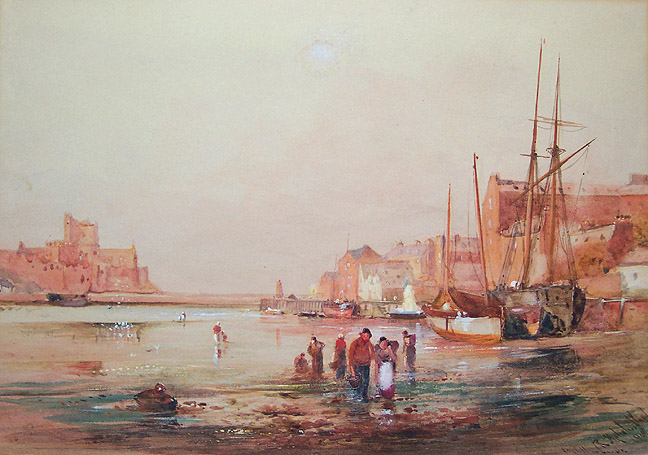
"P(illegible) Harbour", R. Malcolm Lloyd, 9.5" x 13.5", watercolor, dated 1900.
When I re-matted and backed "Rye
from the Hill", I found the title inscribed on the back.
The painting also had an old gallery label with the title
and artist noted, and another label from an earlier owner
noting the the painting had been a wedding gift from "Will
and Minnie Abbot, London, Ontario. July 11, 1927".
Lloyd's first name is given as Robert
in all reference books,but his name was actually Richard,
not Robert, and he was known as "Uncle Dicky" to his
family.

"Bersted",Walter Brookes Spong, 11 3/8" x 9", watercolor, dated June 2, 1915.
Walter
Brookes
Spong
was
born
in
the
London,
England
in
1851
and
died
2
March
1929
in
Nice,
France.
He
was
well
enough
known
at
the
time
of
his
death
that his obituary appeared in the New York Times where he
was described as an English stage and watercolor painter.
He is often listed as an Australian artist because he
moved to Australia in 1886 and was prominent in the art
community there. While living in Australia, Spong was the
chief scene painter with the Brough and Boucicault
Comedy Company and may have accompanied that group to
Australia. Spong was a Foundation member of the Australian
Artist's Association in 1886 and the Victorian Art
Society.
Spong married Elizabeth Twedle, and their daughter, Hilda (1875-1955), was a famous actress in theater and movies, appearing in Australia, Europe, and America. W. B. Spong was a friend of noted Australian artist Arthur Streeton, and others. A letter from Arthur Streeton to Tom Roberts (Croll, Smile to Bulldog, Ure Smith, Sydney, 1946) refers to the sale of two pictures by Spong at the Royal Academy exhibition, London, 1898. Spong is mentioned numerous times in Visual Ephemera: Theatrical Art in Nineteenth-Century Australia by Anita Callaway.

Spong returned to London in 1898. W. B. Spong is listed as a scene painter in the records of the Royal Adelphi Theater, London in 1900. Spong is listed as a scene painter in the records of various Australian and English theater productions and theaters over several decades. The earliest such mention that I have found is for a theater in Bristol in 1870.
His works have been exhibited at
the Royal Art Society of New South Wales, Royal Institute
of Watercolour Painters, Royal Academy (8), Walker Gallery
(66), and Institute of Watercolors in London, among
others. His works are represented in the Australian
National Gallery, Canberra, Art Gallery of New South
Wales, The Manly Art Gallery, The Mitchell Library, Sydney
as well as corporate and private collections in Australia,
the UK, and the US. Spong is referenced in Davenport's Art
Reference and Price Guide, The Encyclopedia of
Australian Art, Australian Watercolour Artists,
Wood's Dictionary
of Victorian Painters, and many other art
reference books.
Hilda Spong sponsored a
retrospective of her father's work at the Anderson
Galleries in New York City in 1921. A young artist named
Howard Leigh was the second artist at the show. Leigh was
an interesting character and painted a picture of Hilda
Spong at the show which she claimed was the best portrait
of her to date. With truth stranger than fiction, I found
two watercolors dated 1943 and 1945 by Leigh for my
collection in an antique shop about one mile from my home,
even though Leigh moved to Mexico in 1937 and died in
1981. The show was reviewed in the New York Times on 18
October 1921. This was the second show for Leigh at the
gallery. The portion of the article regarding Leigh is
included with his biography:
SPONG COLLECTION SHOWN
Water Colors Seen at Reception Given by Artist's Daughter.
A
large
collection
of
very
pleasing
water
colors,
the
work
of
Walter
Brookes
Spong,
are
being
shown
at
the
Anderson
Galleries.
There
are
114
paintings
by
Mr.
Spong,
made
in
fifteen
different
countries,
work which was his recreation in the intervals of scene
painting and made in the places to which he was taken by
his regular profession. It has been a successful hobby,
for the artist has had his pictures hung in the Royal
Academy on the line, and at the Institute of Water Colors.
Mr. Spong has passed the three-score-year-and-ten mark and
with the list of his paintings writes a little account of
his busy life. Much of his work was done in England, where
with one company on tour he painted fresh scenery in every
town he visited. He painted the scene for "Trial By Jury,"
in which Gilbert and Sullivan collaborated for the first
time; the scene for the first act in "Ingomar," in which
Mary Anderson made her first appearance; went to Australia
with Robert Brough and Dion Boucicault, and, coming back
to London, painted, among other things, the scenery for
"The Belle of New York," in which Edna May appeared. It
was through the advice of two American women, Mrs. and
Miss Isabel Bateman, for whom he painted scenery for their
productions at Sadler's Wells Theatre, that he sent his
first picture which was accepted at the Academy.
The greater number of Mr. Spong's
paintings are scenes in England. There are also, a number
of very interesting ones from the vicinity of Naples,
scenes in Belgium that no longer exist, Australia, Ceylon,
Egypt, Wales and Brittany. The pictures are all about the
same size, not large, charming in color, altogether
agreeable and characteristic of the countries they
represent. They are from the portfolio of the artist,
those shown in other exhibitions having been sold. The
exhibition will be open to the public until Oct. 29 from
10 A.M. to 5:30 P.M.
Spong's obituary from the New York Times, 5 March 1929:
Walter B. Spong Dead - English Scenic Artist and Watercolor Painter dies in France at 79.
Word was received here yesterday of
the death of Walter Brookes Spong, well-known English
stage and water-color painter, and the father of Hilda
Spong, the actress, in Nice France, on March 2. Mr.
Spong was approaching his eightieth year, and had spent
a great part of his life in England and Australia,
engaged in scene painting and stage decoration, as well
as following his hobby of water-color painting in the
picturesque regions of Ceylon, Egypt, Wales, and
Brittany.
He had been an exhibitor of
water-color paintings in the Royal Academy and the
Institute of Water-Colors in London, and several
years ago had a large exhibit in New York.

unnamed, Herbert Arnold Olivier, 10" x 13.5", watercolor, 1884.
Herbert Arnold Olivier R.I. was
born 9 September1861 in Battle, Sussex, England and died 2
March 1952 at Hayling Island, Hampshire, England. He was a
London based portrait and landscape painter who studied at
the Royal Academy Schools, beginning in 1881, and where he
won the Creswick Prize in 1882. He exhibited extensively,
including the RA starting in 1883, the R. P., the R. I.
and the Paris Salon. He taught at the Bombay School of Art
in the 1880s. He went to Kashmir with the Duke and Duchess
of Connaught in 1884, which may be where this painting was
done. In 1885 he showed 66 of the paintings from his trip
to Kashmir at the Fine Art Society. The number "63" is
written on the back of this painting in pencil. These
works were considered "effective, though hard and coarse
in colour" by critics. He had a one man exhibition at the
Grafton Galleries in 1908 and was appointed an Official
War Artist in 1917. He was elected to the Royal Society of
British Artists in 1887 and to the Royal Institute of
Painters in Watercolors in 1929 where a major
retrospective exhibition of his work was held in 1935. He
was an uncle of Sir Laurence Olivier, the actor.
He is
mentioned in Mallalieu's British
Watercolour Artists up to 1920, Davenport's
Art
Reference
and Price Guide,
Wood's Dictionary of Victorian Painters, Tate
Gallery Catalogues: The Modern British Paintings,
Drawings,and Sculptures, and other reference books. He may have been
the H. A. Olivier whose work was reproduced in 20 color
plates for The Royal Botanic
Gardens, Kew: Historical and Descriptive, Cassell & Co. Ltd,
London, 1908. His work is published in The
Modern
British Paintings, Drawings, and Sculpture, Chamont, London 1964. In
later life his work tended toward large ceremonial works
using oils. Numerous of Olivier's works are part of the
British Government Art Collection.
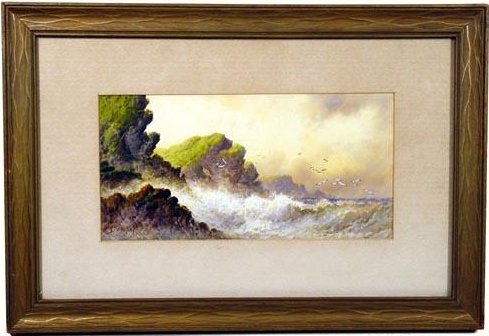
unnamed, W. Stewart, 5" x 10", watercolor.
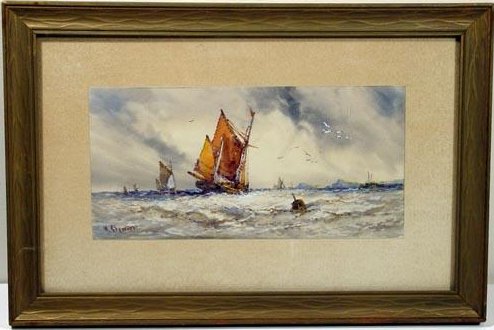
"Smacks Coast Scene Cornwall", W. Stewart, 5" x 10", watercolor.
W. Stewart was likely an English or Scottish painter. Not much is known about him. Prior to my interest in his work, I did not buy watercolors because they are more fragile than oils or acrylics, but I really (REALLY) liked these and they were a bargain, to boot. They probably date from the 1880s or 1890s and are in their original frames. Very nice. The detail and color of these 100 year old water colors is amazing. I just hope I can keep them this nice! See my W. Stewart site for more paintings by this artist and more information about my research on him.

unnamed, W. Stewart, 8.5" x 16.25", watercolor.
Another W. Stewart painting. This one is also in the original frame with a brass plate inscribed "W. Stewart". Very Victorian! I call this one "Fishing Fleet in the Morning".

unnamed, W. Stewart, 6" x 10", watercolor

"Three Trees at Pluscarden
Priory",
Stewart Carmichael, 14.5" x 18", watercolor, signed,
monogrammed, and dated 1932.
Stewart Carmichael (1867-1950) was born in Dundee, Scotland and was an associate of the Celtic Revivalist and symbolist painters John Duncan (1866-1945) and George Dutch Davidson (1879-1901). Carmichael was a portrait and landscape artist, architect, and decorator. Stewart was educated at Dundee High School and studied art in France and Belgium. He painted many historic subjects, including a great patriotic mural for the Dundee Liberal Club, which featured Wallace and Bruce. From English Romantic Art 1850-1920:
"Carmichael described art 'like little green leaves that grow between the stones of the city'. He belongs to the Dundee group of symbolist painters. He was educated at Dundee High School and studied art in France and Belgium. His earlier work was symbolist in style and was often of a romantic or classical subject. He first came to light artistically after completing a series of decorative murals for Public buildings in Dundee. There is no doubt that his early work shows a strong influence of his fellow Dundee painters John Duncan and George Dutch Davidson, although this was not to last, as he turned to more conventional subject matter."
His work is included in the collections of The University of Dundee, and other museums. Carmichael was on the Board of Governors of the University of Dundee for many years. He is mentioned in Johnson's Dictionary of British Artists 1880-1940, Mallett's Index of Artists, The Dictionary of Scottish Painters 1600 to the Present by Harris, and Davenport's Art Reference and Price Guide. His letters are in the care of the National Library of Scotland in Edinburgh. Carmichael was the subject of a flattering five page essay in Contemporary Scottish Studies: First Series, by C. M. Grieve in 1926. He was praised thusly:
"And in the dust that is Dundee Mr Stewart Carmichael, if he is nothing so startling as a trumpet, is at least an elfland horn, serving to maintain an all-too-easily missed but yet never wholly vanquishable note of beauty in the dreariest waste of materialism that contemporary Scotland possesses."
This painting was in a heavy wood and
plaster frame with a nailed on wooden back. This frame
originated in Dundee, as I found when I took it apart.
It bore the label of "Alex. Fraser Gilder and frame
Maker 58 Bell Street Dundee", but Carmichael's painting
was at least the third painting to have graced this
frame, judging by the other old labels I found which
contained the names of two other paintings. Carmichael
inscribed the back of his painting "Three Trees at
Pluscarden Priory Stewart Carmichael 65 Nethergate
Dundee" (Thanks to Mr. James S. W. Barnes for his
assistance in deciphering Mr. Carmichael's address). I
wonder if he sized his painting to fit this frame, or if
it was a happy coincidence? The painting is on heavy
watercolor paper. Carmichael apparently did not want
anyone to forget who created this painting, as he fully
signed it twice and also used his monogram and dated it.

"Near West Wycombe", Thomas Edward Francis, 5" x 7", watercolor, charcoal, and pencil.
Thomas Edward Francis, 1873-1961, was a London landscape painter and an habitual traveler. It was his custom to make long walking tours in the summer months, both on the continent, and in England. He exhibited works under his name, mostly in London in the early part of the 20th century. He also appears to have exhibited works in oils and watercolors under the names "Pierre Le Boeuf", "Arthur Drew", and "Andrea Vesari". Before WWI, he exhibited at the Royal Academy, the New English Art Club, the Royal Society of British Artists, the Nottingham Museum and Art Gallery, the London Salon, etc. His studio at the time was in Robert's Street, near Regent's Park. While executing his watercolors of English villages and countryside, Francis was careful to note in his albums the precise subject, place, and the date and day of each picture.
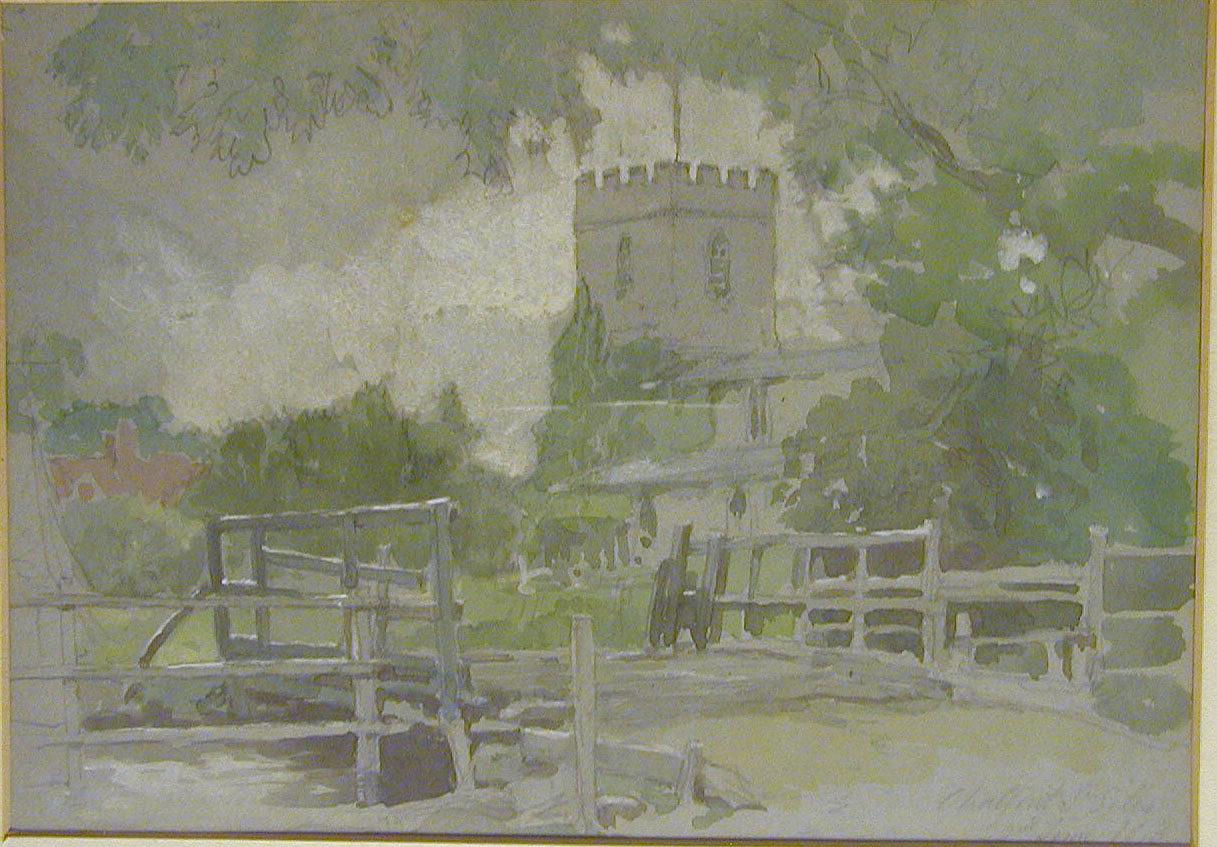
"Chalfont, St. Giles", Thomas Edward Francis, 6.75" x 9.5", watercolor, 1910.
The first painting, a rural study in watercolor with pencil and charcoal highlighting, came from a collection of the artist's work and is inscribed, "Near West Wycombe" in pencil in the lower right corner. I have seen several other works by Francis that are very similar in size and character. The second painting, "Chalfont, St. Giles", is one of his earlier works, and is dated 22 June 1910. It appears to be a watercolor and pencil sketch I think done on gray paper, which supplies the gray colors in the painting. I believe that these two paintings fall somewhere between studies and the artist's more finished works and both may have come from his estate.
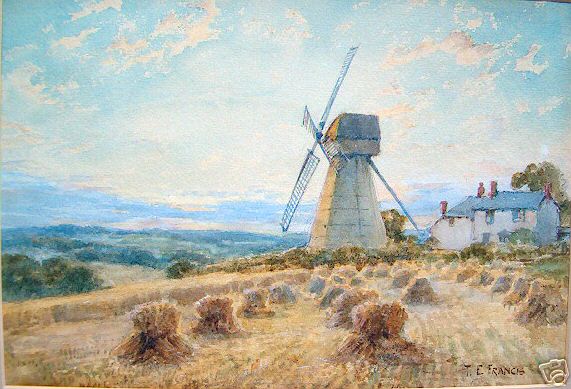
"South Weston (Near Wellington), Oxon", Thomas Edward Francis, 7 3/4" x 11 1/4", watercolor
The third painting seems more like something that Francis would have produced for sale. A note on the back of the painting indicates that this painting was brought from England to Canada in 1912. Francis seems to have been most active before 1940, so may have followed other pursuits than painting in later life.

"Anne Hathaway's Cottage", T. E. Francis, 8" x 10", oil on board.
The fourth painting is not dated, but the inscription "Anne Hathaway's Cottage, Shottery, Warwickshire. Thomas Edward Francis", appears on the back, in addition to his normal signature "T. E. Francis" on the front. This is only painting I have seen on which he signed his name in full. Anne Hathaway was the wife of William Shakespeare and this is the cottage in which she was born and where Shakespeare is reported to have courted her. This painting is yellowed, perhaps having spent part of it's life in the home of a smoker. It seems to be in fine condition under that, though.
Francis is mentioned in Hidden Talents: A Dictionary of Neglected
Artists
by Jeremy Wood, The Dictionary of British Artists by Johnson, Wood's Dictionary of Victorian Painters, and Davenport's Art Reference and Price Guide. Interest in all of
Francis' work seems to be growing, judging by
recent activity in auction records and gallery
representation. He has seemed under appreciated in
my opinion, possibly because he used several
pseudonyms.

"Bare Trees", Stanley Orchart, 20" x 24", oil on canvas.
Stanley Orchart was born in the UK in 1920. He was a landscape artist who worked in watercolors, oils, pen and ink and lithographs. Orchart studied at Leeds School of Art. His work was frequently reproduced as prints. Though often described as working in East Anglia, he also painted in Norfolk, Cambridgeshire, Huntingdonshire, Bedfordshire and Northamptonshire. He was best known for his portrayals of the English countryside in both oils and watercolor. It has been noted that he was in demand for commissions and that Her Majesty the Queen Mother was a major patron of his work, but this has not been confirmed. Stanley Orchart lived in Great Staughton, Bedfordshire, and spent most of his life working in his home county of Bedfordshire and East Anglia. Orchart died in 2005.


"Lisieux", Julius M., 15.5" x 23", watercolor on paper.
Julius
Maximillian
, born in 23 July 1879 in London, England, was a
landscape painter, teacher, and lecturer. He was
elected an Associate of the National Academy of
Design, New York City, in 1945, an Academician in
1948. He was also a member of the American Watercolor
Society; the New York Watercolor Club; the Society of
Graphic Art; Old Dudley Art Society, London; American
Artists Professional League; National Arts Club;
Salgamundi Club; and the Century Club. Delbos exhibited at the
Corcoran Gallery, Washington, D.C. in 1930 and 1937;
Pennsylvania Academy of the Fine Arts, Philadelphia,
in 1930 and 1936; Art Institute of Chicago,
Illinois; New York Watercolor Club, in 1935, where
he won a prize; National Arts Club; Connecticut
Academy of Fine Art; Society of Independent Artists;
American Watercolor Society, winning prizes; and the
Salons of America. Delbos' paintings are in the
collections of the Butler Art Institute, Youngstown,
Ohio; Toledo Museum of Art, Ohio; Brooklyn Museum,
New York; Yale University Artists Guild, New Haven,
Connecticut; and New York Public Library.

unnamed, Julius M. Delbos, 13.5" x 16.5", watercolor on board.
I include Delbos in my British artists section because he was born in and started his career in the UK, though he lived for many years in New York and died in New Jersey. Immigration records show that between 1920 and 1950, he made ten trips from the UK arriving at New York, and once in 1922, he entered the US from Montreal, Canada. I was unable to find him in the 1920 or 1930 US censuses, though he did appear with this parents Leon and Clara A. Delbos in the 1881 English census and on his own in the 1901 English census.

unnamed, Julius Delbos, 14" x 19", watercolor
He is listed in Who Was Who in
American Art, Mallett's Index of
Artists, Mantle Fielding's Dictionary of
American Painters, Sculptors and Engravers, Jacobsen's
Biographical Index of American Artists, Dictionary of
British Artists 1880-1940, and other art
reference books. His auction records in Davenports are
extensive.

Julius M. Delbos
Delbos worked in oils,
watercolors, pencil, and pen and ink. His work was
often used for post cards and in various types of
magazines. I have not yet been able to
discover where Delbos received his early training as
an artist, though he was residing at Bowden College,
Cheshire in 1906. A book, Historic
Cambridge, illustrated by Delbos and
containing pencil sketches of all 26 of the colleges
of Cambridge University was published in 1923. This
is earliest mention I have found of his work as an
artist. He exhibited six paintings at the Royal
Academy as early as 1926.

"Arcadian Fountain", Julius Delbos, 21" x 15", watercolor
Yeah, you guessed it, I like
his work. I think he is an under-appreciated artist.
My very first attempt at purchasing a good watercolor
was a Delbos painting. Below is an example of a pen
and ink drawing by Delbos that was reproduced on a
post card. This card was unused but dates from the
1930s.

"Round Church Str. John's Chapel", J. M. Delbos, 4" x 6", post card
Julius M. Delbos died in Dover, New Jersey on 3
January 1970. His papers, dated 1904-1970 are part
of the Archives of American Art, held by the
Smithsonian. His obituary appeared in the New York
Times on Tuesday, 6 January 1970:
Julius Delbos
Dies at 90
Julius Delbos, an artist
who specialized in water-colors died Saturday at
Dover (N. J.) General Hospital. He was 90
years old and lived at the Mary Heart Nursing
Home in Succasunna, N.J.
Mr. Delbos was a
member of the American Watercolor Society,
the National Arts Club, the Century
Association and the Salmagundi Club. His
works are in the collections of the Corcoran
Gallery and at the White House and Hyde
Park.
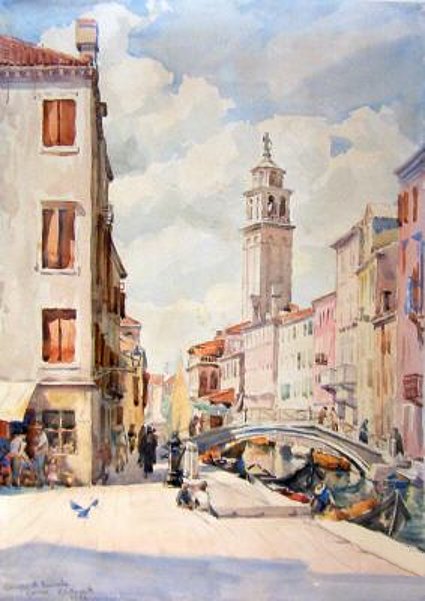
"Campo San Barbana", Venice", William Arnold Stewart, 14"x10", watercolor, dated 1925.
William Arnold
Stewart, 1882-1953, was born in Ilkley, Yorkshire,
England and studied at Bradford Technical College
and the Royal College of Art. He was the chief
textile designer for Lister and Co., Bradford. He
traveled to, and painted in, Palestine, Egypt and
Venice.
Stewart moved to Egypt in 1911 where he accepted a
teaching post at the Department of Arts and Crafts in
the Egyptian Ministry of Education. He was later the
Principal of the School of Arts and Crafts. He worked
for noted Egyptologist G. A. Reisner, reconstructing
some of the furniture of Queen Hetepheres that was found
at Giza. He was a noted Egyptologist in his own right.
He was appointed Supervisor of Technical Education to
the Palestine Government in 1930 and was later made the
Controller of Light Industries.
He retired in 1947 and returned to England, where he died in 1953.
The
Calton Gallery, Edinburgh, had an exhibit titled
"William Arnold Stewart Festival" in 1986 and a book was
generated to commemorate this event. This may be the
same man. I located a copy of this book in the inventory
of a bookseller in France. The description the
bookseller sent me of it was that it was "11 pages with
few images", so this may have been more of a
biographical effort, rather than a collection of his
works, and as the book was rather pricey, I did not
acquire it.
He
is
mentioned
in Who Was Who in Egyptology, Davenport's Art Reference and Price Guide, and The Dictionary of National Biography,
Missing Persons.

"Hay Making", David Law, 9" x 13.75", watercolor
David Law RBA RPE, born 25 April 1831 and
died 29 December 1901 at Worthing, was a landscape
painter and etcher. He was born in Edinburgh,
Scotland and was apprenticed early to George
Aikman, steel engraver. In 1845 he was admitted to
the Trustees' Academy where he studied under
Alexander Christie and Elmslie Dallas until 1850.
He became a 'hill' engraver in the ordnance survey
office, Southampton, and it was not until twenty
years later that he resigned and became a painter.
His daughters, Annie and Beatrice Law, were also
well known landscape painters.
His plates, after Turner and Corot and some modern landscape painters, had many admirers, and from 1875 through 1890 were in great demand, when reproductive etching was fashionable. Law became most famous for landscape etchings, particularly river views of the Thames. A number of his etchings were commissioned by leading art journals of the day. His best and most vital etched work was done from watercolors by himself.
Law was one of the founders of the Royal Society of
Painter-Etchers in 1881. He was an active exhibitor,
and showed at the Royal Academy, Royal Institute of
Painters, Royal Society of Painter-Etchers and
Engravers, Society of British Artists, Fine Art
Society, Dowdeswells Galleries, Agnew and Sons
Gallery and Dudley Gallery. He also exhibited at the
Royal Scottish Society of Painters in Water Colours,
Royal Hibernian Academy, Glasgow Institute of the
Fine Arts, Royal Society of Artists in Birmingham,
Manchester City Gallery and Walker Art Gallery in
Liverpool.
David Law is mentioned in The Dictionary of British Artists
1880-1940,
the Dictionary
of Victorian Painters by Christopher Wood, British Watercolor Artists up to 1920 by Huon Mallalieu, Davenport's Art Reference and Price Guide, and Bryan's Dictionary of Painters and
Engravers,
by George C. Williamson.

unnamed, Georgiana Helen Scott, 7.25" x 8.25, watercolor.
Georgiana Helen Scott was
born in London, England in about 1851 and came to
New York with her father, artist William Wallace
Scott (1822-1905) about 1865. She lived with her
father and stepmother in New Rochelle, New York in
1880 and in Manhattan, New York in 1900. Her
nickname was given as "Georgie" in the 1900 census.
Her actual age is hard to determine as she seems to
have grown younger with each census. In 1880 her age
was 26 (1854), but in 1900 her birth date was given
as September 1860, and her age at the time of her
death was given as 96 (1851). I have not been able
to locate Georgiana in the 1910-1930 censuses,
though she may be the Georgiana H. Scott who is
living with her nephew, George W. Stone, a music
teacher in the 1920 federal census of Nantucket, MA.
Georgiana studied painting under
her father. She showed two paintings at the National
Academy of Design (NAD) in NYC, in 1878 and 1895.
The painting shown in 1895 was #475 in the West
Gallery of the NAD and was titled "Miniature
Portrait of a Child". Her address in 1895 was care
of her father at 1 Madison Avenue, NYC.
She is mentioned in Who Was Who in
American Art by Falk, Jacobsen's
Biographical Index of American Artists V. 1
Book IV, Dictionary
of Women Artists Born Before 1900, Davenport's
Art Reference and Price Guide, and other
reference books. She is often described as a
"miniature painter" but as this and other works
show, she painted in watercolors, as well. Jacobsen
notes that her paintings were held in private
collections in NY and Westchester County. New
Rochelle is in Westchester County, NY.
Georgiana died in on
2 March 1947 in New Rochelle, NY and her obituary
appeared in the New York Times on the day after her
death:
Georgiana H. Scott
Special to the New York Times
New
Rochelle, N. Y., March 27 - Miss Georgiana Helen
Scott, retired miniature painter, whose pictures on
ivory are in many New York and Westchester County
collections, died here today in her home at 44
Church Street. Her age was 96.
Born in London, Miss Scott was a
daughter of William Wallace Scott and Caroline
Scott. Her father was a painter of oil portraits and
miniatures, and in her youth Miss Scott received
lessons from him. She came to this country in 1865
and painted until the age of 85, when her eyesight
began to fail. She was blind at her death.

unnamed, Thomas Collier, 10" x 14", watercolor and gouache on paper
Thomas Collier Jr., was born 12 November 1840 at Glossop, Derbyshire, the son of Thomas and Martha Siddall Collier. His father was a prosperous grocer and tea dealer. Little is known of Collier's youth. He attended the Manchester School of Art before moving to northern Wales in 1864 to paint in the footsteps of his idol, David Cox. Collier next moved to London around 1870, where he was elected to the Royal Institute of Painters in Water-colours in 1870. He was not a prolific exhibitor, but collectors and critics then and today consider him one of the masters of the English landscape watercolor. Collier was made a Chevalier of the Legion of Honor in acclaim of a painting he sent to the Paris International Exhibition of 1878. Hardworking, shy and often in poor health, he was enabled by a family stipend to work without concern for popular tastes and travel to observe the English countryside (especially in Suffolk). In 1879 Collier built a large house and studio in Hampstead (Longdon) where he spent the rest of his life tirelessly perfecting his studio craft and receiving prominent artist visitors.

"The Gravel Pit, Hindhead", Thomas Collier, 12.5" x 20", watercolor
According to Mallalieu, Hardie, and others,
Collier was the best and most important
inheritor of the styles of well known British
watercolor artists David Cox and Peter DeWint.
His works were largely neglected until the mid
20th century, when his skill was the subject of
articles by several prominent art historians and
critics. Though better known today, as a result,
his work is still under appreciated and
continues to be less valued by collectors.
In 1944 Adrian Bury published The Life and Art of Thomas Collier, which contains 84
plates of Collier's paintings, his photograph
and biography. This book was published in a
limited run of 500 copies, and I am fortunate
enough to have copies #107 and #349 in my
library. The second of the two paintings above
bears the inscription on back "T. Collier
Fittleworth Common", which was obviously added
in recent years. Bury's book shows that this
identification is incorrect however, as a nearly
identical rendering of this scene is included in
his plates, and is entitled "The Gravel Pit,
Hindhead". The painting in the plates is
smaller, only 9.5" x 13.5", from a slightly
closer perspective, and may have been a study
before completing the larger work. The smaller
painting was held by the Leeds Art Gallery in
1944.
Collier is mentioned in the Dictionary of
Victorian Painters by Christopher Wood, British Watercolor Artists p to 1920 by Huon Mallalieu, Davenport's Art Reference and Price Guide, Bryan's Dictionary of Painters and
Engravers,
by George C. Williamson, Hardie's Watercolour Painting in Britain,The Dictionary of British Artists
1880-1940,
and numerous other reference books. Examples of
his works are held by the Victoria and Albert
Museum, the British Museum, and numerous other
prominent museums and art galleries.
Thomas Collier RI died 14 May 1891 at Hampstead
and is buried at Highgate Cemetery, Highgate in
his family's plot.
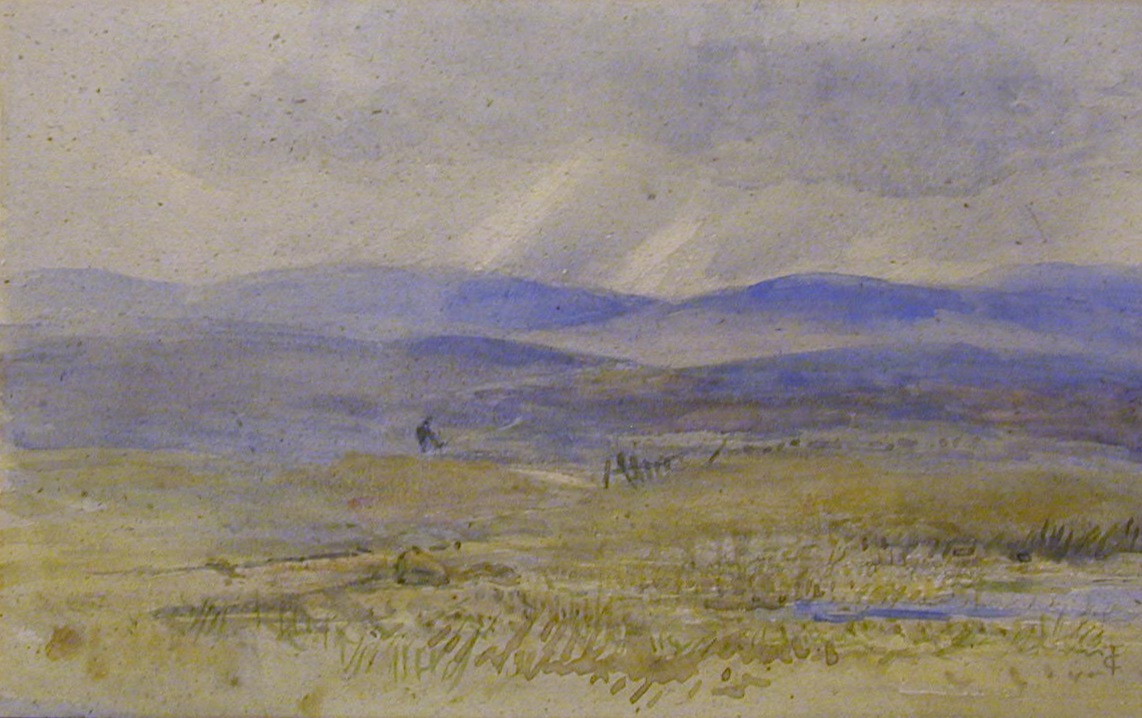
This little painting is
signed with a monogram, a "T" superimposed over
a "C", and was offered to me as "attributed to"
Thomas Collier. Someone has written on the back
"Original watercolour painting by Thomas Collier
RI 1840s 'View in Wales' " and "One of the
supreme watercolour painters of England". Bury
reports in his catalog of Collier's works that
he did sign with the monogram "TC", but does not
give an example. Bury, himself, had one of these
monogrammed works in his collection. I have seen
similar brush strokes in some of Collier's
looser paintings, especially in what looks like
a fence in the center of the picture. There is
some very similar work in "A Countryman's
Anthology" by George Emslie which contains 12
plates by Collier, most of which seem to appear
in Bury's book. I'll leave it to those who know
Collier's work better than I to judge if this
"TC" is Thomas Collier. At any rate it is a
pleasant little painting.

Thomas Collier
1840-1891


unnamed, Dorothy Bishop, 11" x 15", watercolors
Dorothy Bishop (nee
Livermore) was a watercolor artist and painted
florals and landscapes. She was a student of
Sylvester Stannard in the 1950s while living in
Bedfordshire, Sussex, England. She was elected a
full member of the the Society of Women Artists
(SWA) and exhibited extensively (121 works)
there from 1951 through 1996, and also exhibited
at the Royal Academy. Bishop died, perhaps in
early 2006, and a great number of her works came
onto the market afterward. Many of these paintings
are not signed, including the two above, which
were purchased from her estate. I have seen many
such paintings on the market since mid 2006. One
seller theorized that she did not actively sell
her works so did not sign many. I think it more
likely that these works came from her sketch
books. This may be supported by the fact that
signed examples of her work may be found. Some of
her signed and unsigned works are much more
sophisticated than the two shown above.

"The Old Abbey", Dorothy Livermore Bishop, 15" x 11", watercolor on paper
Bishop
does not appear to be listed in any of the major art
reference books. There is a Dorothy Bishop RBA
mentioned as an exhibiting artist in 1938 in The Dictionary
of British Artists 1880-1940, but I think
this is a bit early to be our Dorothy. This same
Dorothy Bishop, an engraver, also exhibited 2 works
at the SWA in 1950. Both times she resided at 4
Abinger Road, Bedford Park, London W8, while our
Dorothy resided at 410A Bedfordshire Lane.
"The Old Abbey", shown above is
signed and titled verso. "Boats on the Sand", shown
below, is signed "Dorothy Livermore"on front, but is
also signed and titled verso.

"Boats on the sand", Dorothy Livermore Bishop, 11" x 15", watercolor on paper

(Mittha
Run?), Samuel Maurice Jones, 10" x 15", watercolor
on board
Samuel Maurice Jones RCA was born
at Mochdre in Denbighshire,
Wales in 1853 and was an illustrator and landscape
painter in oils and watercolors who exhibited in
many of the major UK art galleries. Jones was
the fourth child of the Rev. John Jones, a
Calvinistic Methodist minister, and his wife,
Hannah. He was an early product of
public art education in Wales. Jones
trained under John Cambrian Rowland at the
Caernarfon School of Art, before moving to London,
where he studied from 1870 to 1873 under William Collingwood,
Associate of the Society of Painters in
Watercolours. He was a founding member of the Royal
Cambrian Academy, and, in 1882, became the first
Welsh-born Academician to be granted an Associate
Membership. He was prominent in launching a campaign
in the Welsh language on behalf of visual culture, a
campaign which remained close to his heart
throughout his life.
In 1891 Jones was commissioned by
O. M. Edwards to contribute a series of paintings on
the theme of Welsh houses for his new periodical
'Cymru'. The series of illustrated essays proved to
be extremely popular and were later published in the
book 'Cartrefi Cymru' (1896). I have a
copy of this book and it contains about 15
illustrations, some signed with the monogram "SMJ".
He also provided illustrations for Gwaith Alun, by
Alun aka John Blackwell. This was a book of Welsh
poetry published in 1909 that circulated widely then
and today.
Jones is mentioned in the Dictionary of
British Artists Working 1900-1950 by
Waters, Clarence
Whaite and the Welsh Art World: The Betws-y-Coed
Artists' Colony 1844-1914 by Lord, The Dictionary
of British Artists 1880-1940, the Dictionary of
Victorian Painters by Wood, Welsh Painters
by T. M. Rees, and other reference books.
Samuel Maurice Jones
died in Llandudno, Wales on 30 December 1932.
Samuel's son, J. Maurice Jones, donated his father's
papers to the National Library of Wales in
1967. Several of Jones' paintings are featured
on Gathering the
Jewels, a Welsh web site devoted to preserving
Welsh art.
This painting is in a beautiful
original frame, bearing the perfectly preserved
framer's label verso which reads "Hugo Lang
& Co. Ltd., 19. Whitechapel, Liverpool, Ref
B4989". The reference number is written in pencil.
The back of the painting was still sealed with the
original framer's tape. When I took the painting out
of the frame, I found the following inscription on
back "Ref B4989, 1/2 Mittha Run", At least I read it
as "Mittha Run", though that is only my best guess,
as it is not clearly written.
On a personal note, I was happy
to finally add a painting by a Welsh artist to my
collection. According to a family tradition passed
down for three centuries, my paternal ancestor was a
Welsh carpenter who fell in love with a Welsh
noblewoman. She returned his love but they were
forbidden to marry as he was a commoner. He built a
chest in which he hid his love and smuggled her out
of the country and they came to America some time in
the 1600s. I have proved my ancestry back to William
Daniel, a carpenter, who was born about 1680 and was
living in Essex County, VA by 1707. I believe that
his paternal grandfather, also a carpenter, was in
Virginia before 1660, but won't give his first name,
since I have not yet been able to prove the
connection.

unnamed, J. N. Nash, 5" x 7", watercolor, dated 1939
This artist is most
likely British, as I purchased it from a British
art dealer in Oxfordshire, England. I am real
winter person and like days like this, so it is
nice to escape into a painting like this on one
of our steamy summer days, though I do like
those days, too. Like I say, I like really hot
weather and really cold weather and everything
in between, as long as I can be outside. I find
this to be a visually rich, but relaxing
painting, even though it is fairly tiny. The
back of the painting itself contains the
notation "J. N. Nash 1939" and there is a typed
label on the backing material that says "Water
drawing for Mrs. Graham, J. N. Nash 1939". It
came unframed but in a nice original "French
Mat". I do not think that this is the well known
British artist, John Northcote Nash, as the
signature does not match the ones in my book of
signatures. Any information on this artist would
be appreciated.


"Burton Bradstock, Dorset", 9.5" x 13.5" Mrs.Celia Southall, watercolor, dated 1917
Mrs. Celia Southall was an active painter from about 1917 until about 1949. In 2007 a portfolio of about 100 watercolors painted between these two years was purchased by an art dealer in Essex, England. Mrs. Southall appears to have been an amateur painter as she is not listed in any art reference book. The quality of her work varies greatly over the span of the three decades that she was active. Since I like to do research, I picked up a few of these paintings.

"Derelict Farm, Temple, Guiting", 9" x13.5", Mrs. Celia Southall, watercolor, dated 1947
One of the paintings
bears the stamp of the extinct and obscure
"Banbury Sketch Club", and the seller told
me that several of the others did as well.
Notes on the backs of some of the paintings
indicate that Mrs. Southall exhibited her
work at this club. I have found no other
reference to this club, though notes on the
back of one of the paintings indicate that
there were at least a dozen members in 1921.
She traveled widely, painting in many parts
of the UK, France, Switzerland, and
Italy. Most of her paintings are
signed with the monogram "CS" followed by
the date, though many are also signed "Mrs.
Southall" verso.
I suspect that Mrs.
Southall received her training well before
1917, the date of her earliest known works,
as these early works are well done and
fairly complex. Where she received her
training as an artist is unknown. In 1921
Alice Margaret Celia Southall received some
type of recognition from Birmingham
University, though this may be a
coincidence, and not our Celia, at all. I
believe that Mrs. Southall was the widow of
Thomas Southall, and daughter of Samuel
Price. Thomas and Celia were married in
Birmingham in 1893. Thomas Southall was
deceased by 1929, and possibly many years
previous. Mrs. Southall was the compiler of
a History of the Southall Family that is
currently held by the Museum of Wales. My
current feeling is that she passed a genteel
widowhood in travel and other hobbies,
including painting.

"The River Conway, near Bettwys-y-Coed", Mrs. Gladys Lines, 17" x 13", watercolor
Mrs. Gladys Lines,
nee Entwistle, was born in 28 February 1894
in Adlington, Lancashire, England. She
married Leslie Lines, a mathematics teacher,
on 4 July 1924 at Conway, Caernarvonshire,
Denbighshire. She seems to have painted
under both her married and maiden names, but
was best known under her married name. She
studied at St. Annes on Sea School of Art
and was a teacher of art at Colwyn Bay,
Wales. I suspect that she was also a teacher
at Penrhos College, a girls' school in
Colwyn Bay and I am trying to confirm that.
The inscription on the back of this painting
shows that it was given as a gift to a Miss
E. Evans in August 1949 by her coworkers at
The Ministry of Food Grading Branch, and
contains the signatures of many of those
coworkers.
She is known to have
exhibited between 1920 and 1927 and showed
two paintings at the Royal Cambrian Academy.
She is mentioned in The
Dictionary of British Artists by
Johnson.


unnamed, G. Hanmer Croughton, 6.5" x 4.75",
watercolor
George Hanmer Croughton was born in April
1843 in London, England. He was a painter,
photographer, and illustrator. He studied at
the National School of Arts at South
Kensington under Thomas Sydney Cooper, and
in Antwerp and Paris. He was a member of and
held several positions with the Rochester
Art Club, Rochester, NY starting in 1892,
including vice president and president. He
exhibited at the International Expo in
London in 1863 where he won a medal, at the
Royal Cornwall Polytechnic Exhibit in 1864
where he won a medal, one floral watercolor
at the Society of British Artists in 1874,
and at the Cotton Centennial Exhibition, New
Orleans in 1885 where he won a medal.
He was married in
September 1865 in Bath, England to Charlotte
Morgan. They had five daughters and one son.
None of his daughters married and his son
was committed to an insane asylum before
1920. Two of his daughters became writers.
He emigrated with his whole family to the US
in 1886. He was a frequent traveler to
Europe and I found two references to trips
made on the Lusitania.
Croughton had an early
interest in photography and in 1876 an
article written by him was published in the
British Journal of Photography. He spoke
about his article topic at the Edinburgh
Photographic Society on 2 February 1876. He
was a frequent speaker and writer on the
subject of photography for several decades
both in the UK and the USA. He was a member
and President of the Rochester Camera Club.
Croughton also worked as a photographic
paper manufacturer in Rochester in the early
1900s before devoting himself entirely to
photography and painting. I have seen
several references to his work as an art
critic, probably of photographic art.
He is listed in Who
Was Who in American Art by Falk, Dictionary
of Victorian Painters by Wood, Mallett's
Index of Artists, and Davenport's
Art Reference and Price Guide,
Croughton died at this
home in Rochester, New York on 15 April
1920. His death was reported in the New York
Times on 17 April 1920. His obituary noted
that he was a photographer and painter of
portraits and miniatures and that he had
painted miniatures of the British Royal
Family.
- On line appraisal service
from John Sewell well known Canadian expert on
fine art and antiques. This is a very reasonably
priced on line service from a well respected
expert. Fill out an on line form and send images
of your art objects. No need to send your art
objects through the mails. I am a satisfied
customer! Highly recommended!
- Here is a list of common British art society abbreviations.
- Images
of art works by 29,000 artists. I use this site
to compare works that I am interested in or own
to other works by the same artist. A good place
to spend some time just cruising, too!
Pennsylvania Artists Texas Artists New England Artists Other Artists
UK Artists Canadian Artists South American Artists Asian Artists European Artists
Unknown Artists Unknown Artists 1 Unknown Artists 2 Unknown Artists 3
HOME